

How DEN turned a module choice into a global education
Joshua Morton, second-year English Language and Linguistics student, University of Westminster, United Kingdom
Part of the Inside Westminster anniversary series marking ten years of the Democratic Education Network.
How did you first come into contact with DEN?
For my entire first year at Westminster, I was unaware of the Democratic Education Network. I first encountered it in my second year when I enrolled in the module Democratic Engagement in an International Context. I chose this elective because I was keen to explore something beyond Linguistics and to develop my growing interest in politics and international issues.
One of the main reasons I selected the module was the additional field trip to Thailand, an opportunity I was determined not to miss. Before this, I had never travelled outside of Europe, so the chance to visit Thailand as part of an academic programme was something I felt particularly excited about. I was also drawn to the module’s focus on contemporary global issues. From there, I gradually became more involved in DEN meetings and activities outside of class, and it quickly became much more than just another university module for me.
Which DEN activities have you taken part in?
In my time as a member of DEN, I have had multiple opportunities to take part in international activities. Some of the most enjoyable have been the field trips to Thailand and Uzbekistan, where we participated in Model United Nations conferences at Kasetsart University in Bangkok and at Westminster International University of Tashkent. I also took part in a conference on student leadership organised by DEN for students from the Chinese University of Hong Kong.
Was there a moment at DEN that has stayed with you?
If I had to pinpoint a particular moment, it would be having my first blog uploaded to the online DEN magazine. I remember Farhang sending it back to me as a link to the online magazine, and it was a real “wow, I wrote this” moment. It is difficult to express how proud of myself I felt at the time. Seeing something I had put a lot of effort into being uploaded to the magazine felt like a real achievement, and one of the first things I did was tell my family. Although it may seem like a small thing, it gave me a real sense of accomplishment and was a step in the right direction in my journey through higher education.
What aspects of DEN have had the biggest impact on you?
One aspect of DEN that has had a significant impact on me is the opportunity to engage with people from different cultures and backgrounds, both at Westminster and through international experiences abroad. Meeting students from different countries and seeing different parts of the world firsthand taught me things I could never have learned in a classroom alone. These experiences broadened my understanding of different cultures and perspectives, and made me appreciate how lucky I am to study in London and have access to opportunities such as these.
How has DEN helped you develop personally?
DEN has helped me develop a range of skills that have benefited me throughout my studies and will continue to be valuable in the future, particularly in public speaking, teamwork and giving constructive feedback. When I first joined DEN, I found it very difficult to speak publicly and often struggled to articulate my ideas so that they flowed naturally. Through DEN meetings, workshops and Model United Nations conferences, I gradually became more confident in speaking in public and contributing to discussions. Working in teams to lead sections of DEN meetings, peer reviewing blogs, and helping with the editing process for the DEN book has also developed my ability to give constructive feedback and work effectively as part of a team.
I have seen a noticeable change in other aspects of my studies. These skills have helped me deliver presentations more effectively in my course modules. They were also evident during my participation in the Humanities Hackathon, a university event where teams of students worked together to solve problems set by employers. Throughout the event, I worked closely with my team to develop our ideas, give constructive feedback and refine our final pitch. Each team had to present their solution, with the winning pitch being presented at the Regent Street Cinema in front of a large audience. Our team’s pitch was selected, and I delivered the presentation at the cinema without notes, and with a level of confidence I would not have had before joining DEN.
Has DEN helped you with employability or professional development?
I have not yet used my experience in DEN in a professional career context. However, it has contributed to my employability and professional development by helping me build transferable skills and strengthen my CV. Through activities such as Model United Nations conferences, peer reviewing work, contributing to the editing of DEN’s annual book, writing blogs and speaking publicly, I have developed skills I can take forward into future roles.
What is one thing DEN has given you that you would have struggled to find elsewhere?
One thing DEN has given me that I would have struggled to find elsewhere is the opportunity to collaborate with students and institutions from a multitude of countries through both structured and informal interactions. This has allowed me to learn far more than I would have in a purely classroom-based university environment.
What advice would you give to students thinking of joining?
My main advice would be to go to a DEN meeting and see what it is like for yourself. Get involved and engage with it, and if it is not for you, that is fine, but even attending one session can make a real difference to your university experience. The more you get involved, the better the experience becomes. It is an opportunity that can open unexpected doors.
What would you say to a colleague at another university?
DEN is a student-led initiative that provides a platform for student voices through conferences and publications. Each week, students peer-review blogs and discuss them in meetings, as well as collaborating with external organisations who engage with students to understand their perspectives. It is valuable because it allows students to express their views and opinions while engaging with a wider global community, and because it develops key skills such as communication and critical thinking.
Should DEN do anything differently in the next decade?
DEN is already doing a really good job of providing students with opportunities to engage with global issues and take part in meaningful activities. Over the next decade, it could benefit from increasing its visibility among students in other courses beyond Politics and International Relations, as many are likely unaware of what it offers. Making it more accessible across a wider range of disciplines would help ensure that more students with an interest in these areas are able to take part, while continuing to build on the strong work it is already doing.
* * *
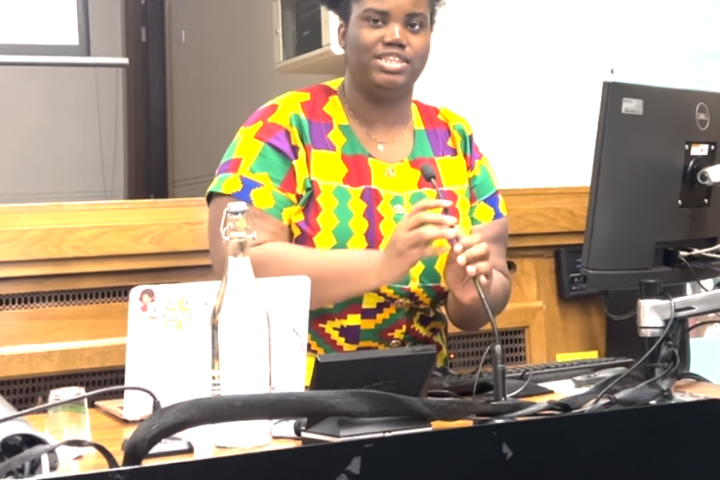
Photo caption: “Wow, I wrote this.” How DEN turned a module choice into a global education.

That’s a neat title, makes me wonder what inspired the writing. Did you have a specific moment in mind?