The history of the Caribbean is rooted in the lives of its Indigenous peoples, such as the Kalinago and Taíno communities, who sustained themselves through fishing, agriculture, and careful use of natural resources. This long-established way of life changed dramatically from the 15th century onward as European powers—including Spain, Britain, France, and the Netherlands—began colonising the region.
Colonisation introduced violent systems of exploitation. The transatlantic slave trade led to the displacement and enslavement of Indigenous groups and millions of Africans, whose labour built the foundation of Caribbean economies. These islands evolved into plantation colonies that enriched European capitalism through the production and export of sugar, tobacco, and other commodities.
A turning point came in 1804, when Haiti became the first Caribbean country—and the first Black republic in the world—to successfully overthrow slavery and colonial rule. Throughout the 19th and 20th centuries, other Caribbean territories gained independence. However, while these nations achieved political independence, many of them inherited economies shaped by dependency. Their economic structures remained closely tied to foreign markets, international finance, and external political influence, leaving them with limited room for autonomous development.
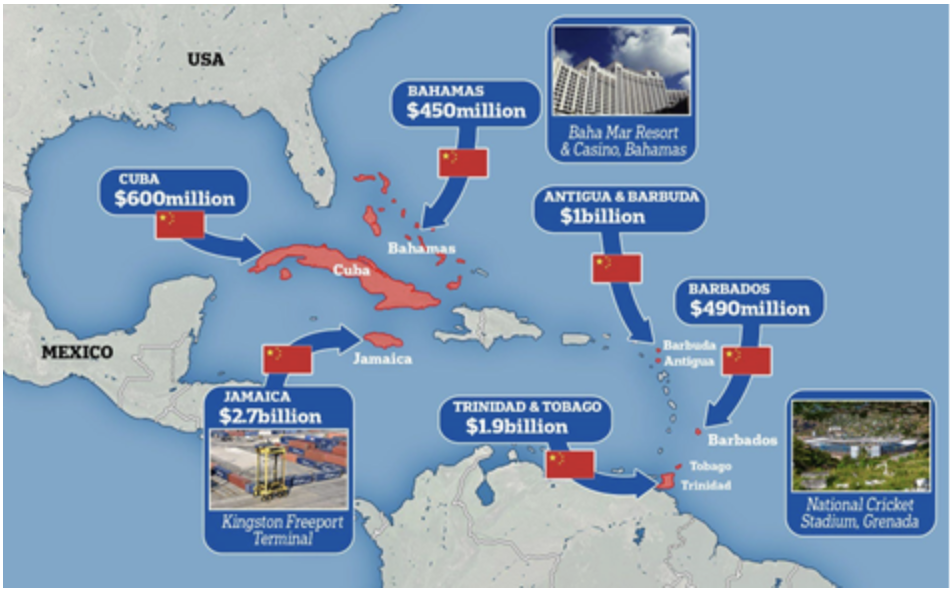
In the contemporary era, the Caribbean continues to be influenced by global powers. One of the most significant actors on the world stage today is China. Strategically, China’s involvement makes geopolitical sense: the region’s proximity to the United States echoes Cold War patterns, such as the Soviet Union’s missile presence in Cuba.
– China has invested heavily in infrastructure across the Caribbean, including:
– Grenada’s National Cricket Stadium
– The National Academy for the Performing Arts (NAPA) in Port of Spain, Trinidad
– St Paul’s Primary School in St Kitts
– Renewable energy initiatives
– Telecommunications, such as Huawei technology networks
As a result, China has become the Caribbean’s top trading partner. These investments bring certain benefits—improved infrastructure, new economic opportunities, and increased diplomatic bargaining power for Caribbean governments. They also help Caribbean states keep pace with global development trends.
However, there are serious concerns. Many of these projects are financed through loans that small island states may struggle to repay, creating the risk of debt-trap diplomacy. This situation echoes old patterns of dependency, where economic reliance limits political autonomy.
Moreover, China often brings its own labour, materials, and contractors, which means that local economies do not fully benefit from these projects. Instead of strengthening domestic industries, these investments frequently reinforce dependency on external powers.
While the contemporary situation is not equivalent to the brutality of the slave trade, the underlying dynamic—a powerful external actor shaping the region’s development in its own interests—raises important questions. In many ways, Caribbean states are still navigating the long shadows of colonialism, now expressed through new global relationships.
Ultimately, the Caribbean’s struggle is not simply about replacing one partner with another; it is about building the economic strength, autonomy, and resilience needed to move beyond cycles of dependence that began centuries ago.
Anaiya Tyson-Cox