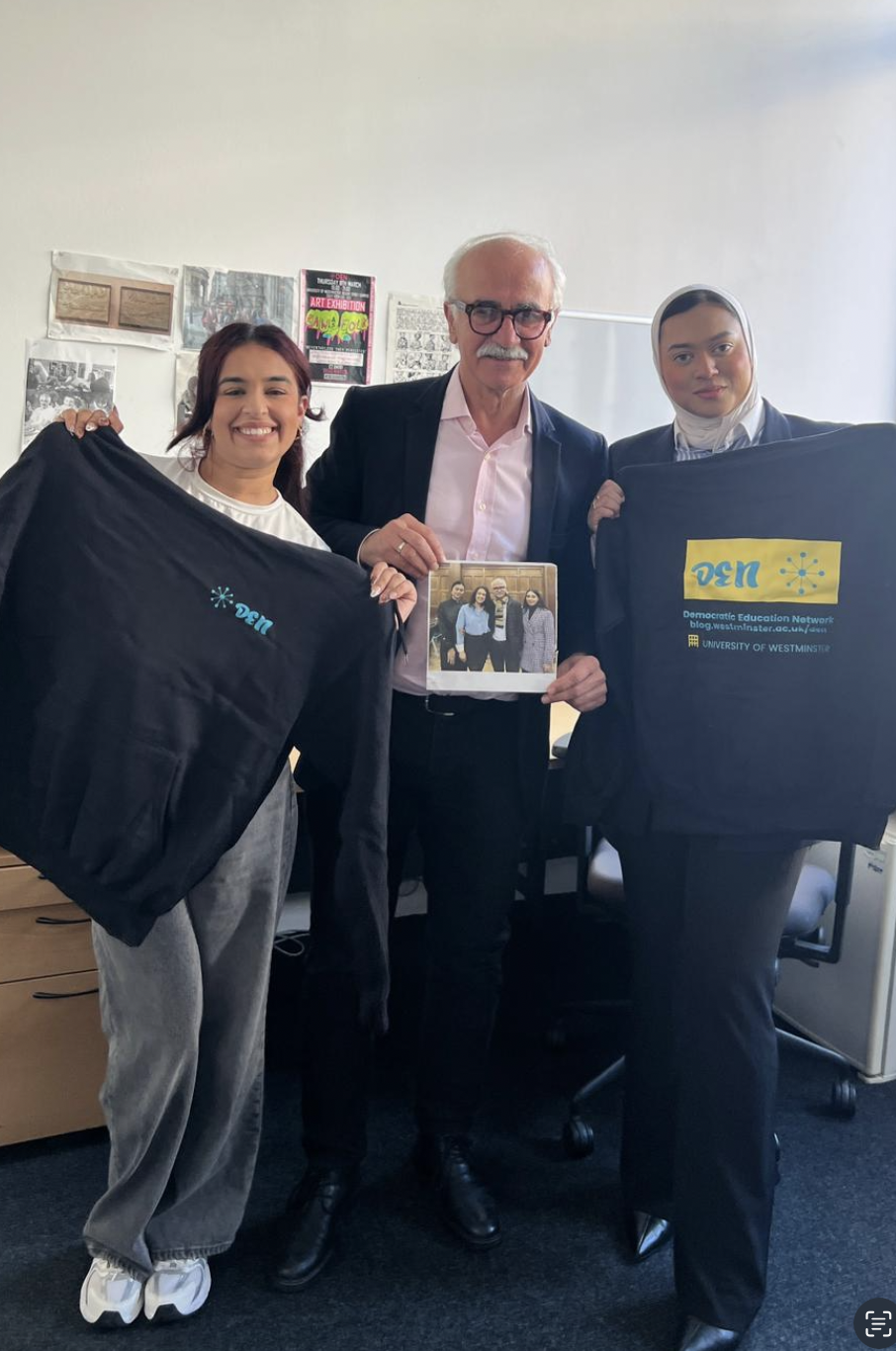
As part of our Alumni Voices series, we spoke with University of Westminster graduate Gabriele Piazza, who is now pursuing an academic career at the London School of Economics (LSE). In this interview, Gabriele reflects on his journey from student to early-career academic, highlighting the pivotal role that the Democratic Education Network (DEN) played in shaping his development.
He shares insights into his time editing two volumes of DEN’s student publications in 2018 and 2019, and how these hands-on experiences helped him grow both personally and professionally. Gabriele also speaks about his enduring connection to the University and the impact of studying BA (Hons) Development Studies and International Relations between 2008 and 2011.
Can you tell us about your time as a student at the University of Westminster?
What did you study, and what stands out most from your experience?
I started out studying International Relations, but pretty early on, I realised I was more drawn to questions around economic development and inequality. That’s when I decided to switch to International Relations and Development Studies.
My time at Westminster was honestly one of the most formative periods of my life. It was after the financial crisis, and I remember feeling like what we were learning was directly connected to what was going on in the world around us. But more than anything, what really stuck with me were the people. The academic staff genuinely cared—not just about how we were doing academically, but about us as people. There was this real sense of community between students and staff that I haven’t experienced anywhere else. I’m still in touch with many of the friends and lecturers from back then.
What inspired you to pursue a research and academic career after graduating?
Were there any key moments, lecturers, or courses that influenced your direction?
There wasn’t a single turning point—it was more of a gradual process. But a few key moments and people really shaped my path. First, I realized that I could actually belong in academia. My parents didn’t go to university, so it wasn’t something I had grown up imagining for myself. But at Westminster, I found that if I worked hard and stayed curious, I could do well. That gave me the confidence to keep going.
I was genuinely passionate about what I was studying. I remember taking a Political Economy course in my second year and being completely drawn in. I started to realize that many of the questions I cared most about—around inequality, development, and power—were deeply tied to the economy. That led me to pursue an MSc at LSE and train as an economist.
What really inspired me to consider an academic path, though, were the people. Farhang, at Westminster, had a huge impact on me. His intellectual curiosity, the way he genuinely cared about students, and his belief that academic work can have real-world impact in whatever small form—those things stayed with me. And he wasn’t the only one. Throughout my studies, I met other role models with those same qualities: thoughtfulness, depth, and a commitment to both ideas and people. That combination is what ultimately drew me to a career in research and academia.
How does it feel to now be on the other side — researching, teaching, and mentoring students — having once been in their place?
What have been some of the biggest challenges or surprises in making that transition?
Being on the other side now—researching, teaching, and mentoring—feels both surreal and like a real privilege. I still remember what it was like to be a student: full of questions, trying to make sense of the world, and often unsure of where I was headed. Now, having the chance to support others through that same process is incredibly meaningful.
Throughout my own journey, many academics had a profound impact on my life. Their encouragement, curiosity, and care helped shape the way I see the world—and myself. So to now be in a position to give even a tiny fraction of that back feels like an honour, and it really pushes me to do my best. It’s not something I take lightly.
At the same time, it can be daunting. The responsibilities are wide-ranging—you’re not just teaching or writing; you’re also mentoring, advising, and constantly learning yourself. And coming from a background where university wasn’t a given, there are still many moments when imposter syndrome still creeps in. But those are also the moments that remind me why this work matters. The chance to be part of someone else’s journey—to help them grow and figure things out—is both humbling and energizing.
In what ways has your education at Westminster influenced your approach to research and teaching today?
My time at Westminster shaped both how I think about research and how I approach teaching. Even though I eventually moved into economics and followed a slightly different academic path, the foundation I got there stayed with me. In terms of research, Westminster instilled in me the idea that academic work should engage with the world—it should matter beyond the university and contribute to broader social understanding and change. That’s a principle I carry into my work today.
When it comes to teaching, what made the biggest difference for me as a student was having passionate lecturers who genuinely cared about our learning. They created an environment that was both supportive and intellectually stimulating. That experience taught me that care and curiosity can go hand in hand, and now I try to bring that same approach to my own students. I aim to be present and engaged, and to show that their growth matters. And just as importantly, I see teaching as a two-way process—I learn from my students as much as they learn from me. That exchange keeps the work meaningful and alive.
Were you involved in the Democratic Education Network (DEN) as a student?
If so, what initially drew you to it?
The Democratic Education Network (DEN) didn’t exist in its current form when I was a student—it was more in its embryonic stage. But there were already early initiatives that captured the same spirit. These were student-led projects supported by the department, especially by Farhang, who really championed this kind of collaborative and student-driven work.
One moment that stands out was in my first year, when we travelled to Turkey to take part in a development conference. Farhang encouraged us to organise the trip ourselves—he trusted us, gave us real responsibility, and treated us as equals. Some of us presented our work at the conference, which was a hugely empowering experience. It broke down the traditional divide between students and academic staff and made us feel like active participants in a shared intellectual community.
The following year, we helped organise a conference in London, continuing that momentum. That sense of ownership and trust was transformative—and in many ways, it planted the seeds of what DEN would later grow into.
What were the most significant aspects of your involvement in DEN?
How did being part of DEN contribute to your personal and professional growth?
One of the most significant aspects of being involved in the early version of what would become DEN was the sense of agency it gave us as students. We weren’t just taking part in projects—we were trusted to lead them. Whether it was organising a trip abroad, liaising for funding, managing a budget, or helping to coordinate a conference, these were responsibilities that went far beyond the typical classroom experience.
That kind of hands-on involvement had a huge impact on my confidence. It showed me that I was capable of taking initiative, navigating complex tasks, and contributing meaningfully to something bigger. Those experiences stayed with me and shaped how I approach both academic and professional work today. Being part of DEN laid the groundwork for how I collaborate, how I manage projects, and how I now mentor students in similar situations. It was formative in ways I couldn’t fully appreciate at the time—but looking back, it gave me skills and a sense of belonging that have made a real difference.
You also served as editor of DEN’s student publications in 2018 and 2019.
How did that experience support your development, both as a student and as an emerging academic?
By the time I served as editor of DEN’s student publications in 2018 and 2019, I was already working. Farhang invited me to support the book project, and I saw it as an opportunity to give something back. I approached the role the same way he had guided us as students: by encouraging students to take the lead and acting as a facilitator of the process, rather than directing it from above. In the end, though, I got back more than I gave—the experience was incredibly enriching and rewarding on a personal and professional level.
That experience taught me a great deal—not just about editing and writing, but about managing complex projects and working with people. I had to balance multiple contributions, guide the structure and tone of the publication, and help students refine their work while making sure their voices remained central. It was demanding but it gave me hands-on experience in project management, editorial work, and academic mentoring.
More than anything, it reinforced the idea that learning and knowledge production are shared efforts. Supporting others in shaping their ideas and seeing them published was incredibly rewarding, and it helped strengthen many of the skills I now rely on in my academic career.
What areas of research or teaching are you currently focused on?
How do you incorporate your experience as a student into the way you now work with your own students?
Over time, my work has moved more toward economics, with a focus on innovation and the broader impacts of investing in science for society. I’m especially interested in the relationship between public investment, private sector behaviour, and long-term structural change. At the core of my research is a concern for how innovation systems can be shaped to support more inclusive economic development. In many ways, this interest has its roots in my time as a student at Westminster, where I was first exposed to big-picture questions about development, inequality, and how policy decisions shape people’s lives.
That experience as a student at Westminster continues to shape how I teach today. I remember how empowering it was to feel supported, to be trusted, and to have space to grow. I try to bring that same ethos into my own teaching—creating a classroom environment where students feel encouraged to ask questions, take initiative, and connect what they’re learning to the world around them. I also see teaching as a mutual process: I learn from my students just as much as they learn from me. That sense of shared learning and intellectual curiosity is something I try to carry forward in everything I do
What advice would you give to current students considering postgraduate study or an academic career?
For students considering postgraduate study, my first piece of advice would be to take your time. Unfortunately, postgraduate courses are becoming more and more expensive, so it’s worth thinking carefully before jumping straight in. Spending a couple of years working can be really valuable—not only financially, but also in helping you figure out whether further study is truly the right path for you. That real-world perspective can give you clarity and motivation if and when you do decide to return to study.
I’d say something similar to anyone thinking about an academic career. It might sound like a cliché, but passion really does matter—especially if you’re considering a PhD. It’s more of a marathon than a sprint, and it takes a lot of internal motivation and resilience. You have to really care about the questions you’re exploring, because that curiosity is what will keep you going through the inevitable challenges.
And one more thing—choose your supervisors carefully. These will be the people you work most closely with, and their support and guidance can make a huge difference to your experience. I’ve been lucky with mine, and it’s something I’m incredibly grateful for. A good supervisory relationship can shape not only your project but also your entire academic journey.
If you could go back and give your student self one piece of advice, what would it be?
If I could go back and give my student self-one piece of advice, it would be to enjoy the experience a bit more. Be curious, get involved, ask questions, and don’t be afraid to have opinions. University is a rare time when you can really explore ideas, try things out, and start shaping your own path. Time goes quickly after that, and you often don’t realise how special that time and space is until it’s gone.
I also know that being a student today is more challenging than it used to be—rising costs and financial pressures can make it harder to fully engage. But if you can, try to carve out time for things that go beyond lectures and exams—like initiatives such as DEN. Getting involved in those kinds of projects can be just as important as what you study, and they often shape your personal and professional growth in unexpected ways
How important has mentorship been in your academic journey?
And how do you now approach supporting and mentoring your own students?
Mentorship has been absolutely crucial in my academic journey. I’ve been lucky to have had excellent mentors at every stage—from my time at Westminster with Farhang, to my current supervisor at the LSE. I’ve always had people who believed in me, who encouraged me when I doubted myself, and who showed me what thoughtful, impactful academic work can look like. And this support wasn’t limited to academia—mentors outside the university context have also played a big role in helping me navigate career decisions, life challenges, and personal growth. That kind of belief and guidance made a lasting difference—not just to my academic progress, but to my confidence and sense of direction more broadly.
Now that I’m in a position to support students myself, I try to carry those lessons forward. I see mentorship as more than just academic guidance—it’s about being present, listening, and helping students develop their own voices. I aim to create an environment where they feel respected, supported, and encouraged to explore the questions that matter most to them. And just as my mentors trusted me, I try to offer that same trust to my students—because I know how powerful it can be when someone believes in you before you fully believe in yourself.
In your opinion, what could universities do better to prepare students for both academic and non-academic career paths?
I think universities can do more to help students prepare for both academic and non-academic career paths by focusing on the kinds of skills that are valuable across the board—like interpersonal skills, communication, and confidence. Initiatives like DEN are a great example of this: they give students a chance to lead, collaborate, and engage with real-world issues, which is incredibly valuable no matter what path they go on to pursue.
Another important area is digital literacy—especially when it comes to emerging tools like generative AI. Rather than avoiding it, universities should help students learn how to use AI effectively and ethically, while still developing their own critical thinking, writing, and analytical skills. Asking the right questions will matter more and more in the future.
The goal shouldn’t just be to prepare students for a specific job, but to equip them with the adaptability and confidence to navigate complex and changing environments—whether in academia, industry, or elsewhere.
What excites you most about your field today?
What excites me most about my field today is the growing attention to the relationship between innovation and broader societal outcomes. I’m particularly interested in how technological change—especially advances in AI—is shaping labour markets, transforming industries, and affecting inequality. These are not just technical shifts; they raise deep questions about power, access, and the kind of future we want to build. The distributional effects of innovation are becoming more visible, and I see real potential for research to inform more inclusive and forward-thinking policy.
Looking ahead, I see my work evolving toward understanding how we can design innovation systems that are not only efficient but also prioritise public value and shared prosperity. This includes studying how public investment can steer technological development in socially beneficial directions, and how institutions and governance frameworks can better respond to rapid change. With the pace of innovation accelerating, these questions feel more urgent—and more exciting—than ever.
Do you still maintain a connection with the University of Westminster?
What does being an alumnus of the university mean to you?
Staying connected to the University of Westminster means a lot to me because of the impact it had on my life. Being an alumnus is about more than just having studied there—it’s about maintaining a link to a place that gave me so much and helped shape who I am, both personally and professionally. I’m still in touch with people I met during my time there, and that ongoing connection reminds me of where I started and how far I’ve come. It’s a relationship I really value.
Finally, is there anything else you’d like to share with current students or fellow alumni?
To current students, I’d say: engage with the life of the university beyond the classroom. Academic work is important, of course, but some of the most valuable learning happens through activities, initiatives, and the connections you make along the way. As I mentioned earlier, try to enjoy the process—be curious, get involved, and don’t rush through it. It goes quicker than you think.
To fellow alumni, I’d say: stay connected. Maintaining a link with the University of Westminster is a meaningful way to honour what the university gave us—and to give something back, whether through mentoring, collaboration, or simply staying in touch.