
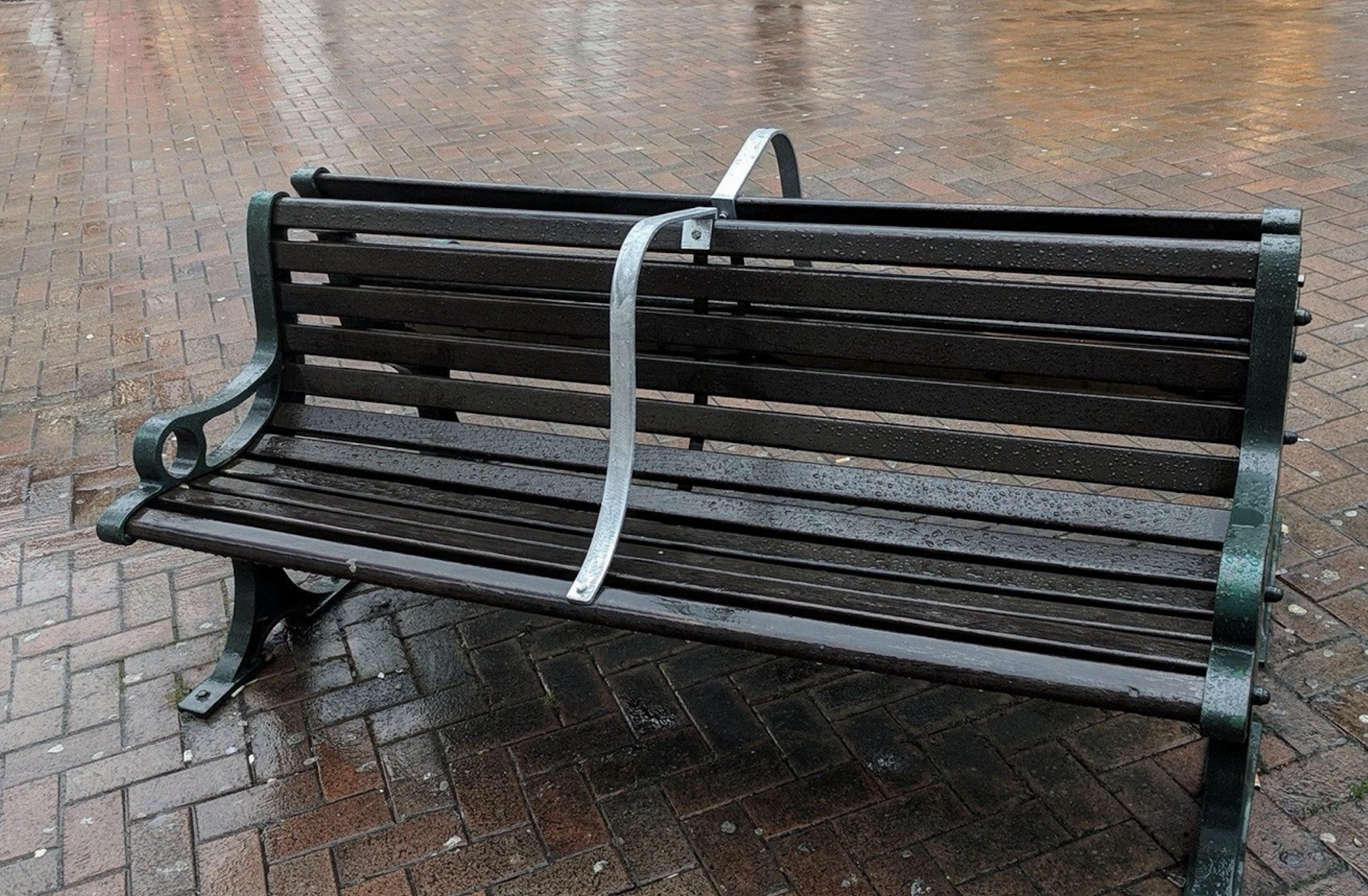
When you are coming home or going to work, how many homeless people do you see on your way? But when night falls and we are safe in our homes, have you ever thought about the struggles of their night?
In one of my year 2 modules, Democratic Engagement in an International Context, this week, we have been discussing the understanding of what a public space is. One example brought up by everyone was the park, because it is a space made for people to express themselves and have a moment of leisure. Part of our discussion was to identify who owns and regulates those spaces. Questioning whether all individuals and activities are welcome in that public space.
After some brainstorming, one question that stood out for me was: Who creates those spaces? Are they created to meet the public needs? The quest to shape cities, towns, or to build other environments is called Urban design. When it comes to urban design, it is important to think about accessibility, for example, by re-designing ramps for wheelchair users or the spinning cone at the bottom of the push-box at the traffic light for visually impaired people.
In the past few years, the government has been redesigning urban designs to meet more people’s needs. So, if they are created for people’s needs, why are homeless people so often neglected? For example, the government has been changing urban designs to hostile architecture. As an example, benches have been added with armrests to avoid having people sleeping there. On the pavement, spaces under bridges, where, before, could have been a shelter, are now being adorned with spikes, leaving them unusable. An article from Single Homeless Project (SHP) exemplifies the consequences of this type of restriction: “Hostile architecture only makes that reality worse, stripping away what few places of shelter remain. Denying people not just dignity, but the basic human need for rest. It’s inhuman.”
So, what is the solution? How could you help? Are there not charities helping with this already?
Firstly, charities do what is within their capacities, but they rely on public support. The focus is mainly on food banks, but also on helping with homeless shelters. But many of those shelters are under government jurisdiction. As a result, those areas get easily packed and are not always equipped with the best materials and support. Leaving them with a shortage of space, no privacy, scarce hygiene, both personal and the structure where they reside. What can you do? Donate to your local charity. When you see them asking for help, try to buy a meal deal if you are not comfortable giving money. It costs nothing to be kind to another human being.
Bibliography:
Ruetas, F. (2020). 15 Examples of hostile architecture around the world – RTF | Rethinking The Future. [online] RTF | Rethinking The Future. Available at: https://www.re-thinkingthefuture.com/designing-for-typologies/hostile-architecture-anti-homeless-architecture/.
Single Homeless Project (2024). Hostile architecture and its impact on homelessness – Single Homelessness Project. [online] Single Homelessness Project. Available at: https://www.shp.org.uk/homelessness-explained/hostile-architecture-and-its-impact-on-homelessness/.
Maria Paiva


We truly need to practice and exercise the citizenship we once learned in our homes and schools in order to make public spaces more pleasant and easier to visit. Excellent material. Congratulations!!!