
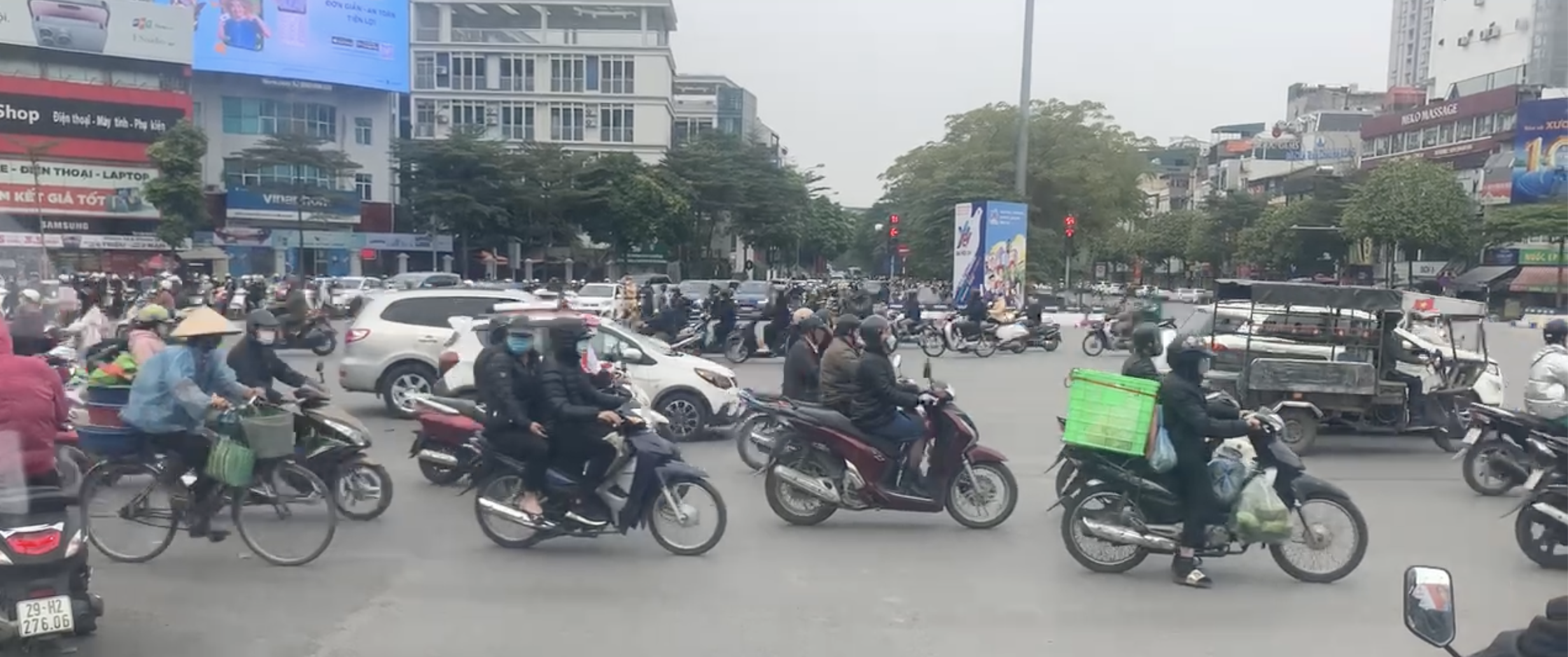
Vietnam is a Southeast Asian country bordered by Cambodia, Laos, and China and currently has a total population of 100 million in an area of about 300,000 square kilometres. After the Vietnam war, Vietnam experienced an economic boom in the late 1980s, increasing urbanisation, globalisation, and industrialisation. While the country is known for its scenic views and vibrant history, there is a huge contemporary issue happening within the capital city, Hanoi. The city has been experiencing environmental issues ever since the economic boom for various reasons, but the main issue is the handling of pollutants. However, not all hope is lost, as the Vietnamese government are doing things to tackle pollution.
The first type of pollution happening within Hanoi is air pollution due to the most popular form of transport within the city. Within Vietnam, the whole country has over 45 million motorbikes, with 86% of the population owning one. These bikes typically use petrol, which produces about 2.3035kgs of CO2 per litre burnt, and considering how many bikes are in the nation the amount of carbon released per day it is clear as day as to why there is a smog issue. The most recent example of this would be earlier this year in March when Hanoi was covered in a thick fog, and this decreased visibility significantly. According to a 2021 report, the 8 million registered vehicles make up about 30% of air particulate pollution, while industry pollution contributes another 30%. (Reuters, 2024). However, the Vietnamese government want to decrease the carbon emissions by possibly banning motorbikes by 2025 to reduce congestion and emissions. This would mean that the traffic caused by motorbikes would stop completely, however this is not realistic as 2025 is in 3 months and Hanoi seems to have no plans to stop using the bikes.
Secondly, there is the issue of green spaces within the city. Parks are natural carbon sinks, which help to decrease the amount of carbon dioxide in the air. One single tree absorbs about 10kg of CO2 for the first 20 years of its life, which means within a year only 0.5kg of CO2 is absorbed. Once the tree is burnt, the carbon dioxide that the tree absorbed throughout its lifetime is released once again. (Hanson and Ranganathan, 2017). Due to increased urbanisation, more trees are being cut down to make space for creating more homes. This process actually increases the amount of carbon dioxide within the air, making the pollution problem worse for the people living in the nation. Thus, the air quality which would be maintained naturally is not able to work to the best of its ability, making the environmental issue worse. On the other hand, the government have approved a plan to plant one billion trees nationwide by the end of 2025. This would increase the levels of carbon dioxide being absorbed, while also giving the city a cleaner look. This in turn would help to incentive the people to clean the city aswell, making it a sustainable option.
In conclusion, too many carbon emissions are being released by the people of Hanoi due to using motorbikes and the cutting down of green areas. However, the government is creating strategies to combat environmental issues, namely the ban on motorbikes and the plan to plant 1 billion trees countrywide by 2025. The problem here, however, is whether these strategies will actually work or not.
Afra Bhuiyan




stripchat
Süße Camgirls,sexgeile amateure und geile voyeur-cam in den sovereign coupling cams subsist erleben. Contemporary Making out Cams as a mending to Emancipated mit Rap in Deutsch, Star-Shows, Chats, Videos: Alles inklusive. Jetzt testen.
nudelive Chatten, Daten, Videos und vieles mehr. Jetzt gratis anmelden! Indecorous Single-Chat. Dilettante Drehtreff. cams4unencumbered
,http://www.mydirtyhobbyd.ink – camgirls