Ten years in, the founder of the Democratic Education Network on the Iranian Azerbaijan childhood that shaped his teaching, the 2016 conversation that became DEN, and the daily practice of a room where students set the terms
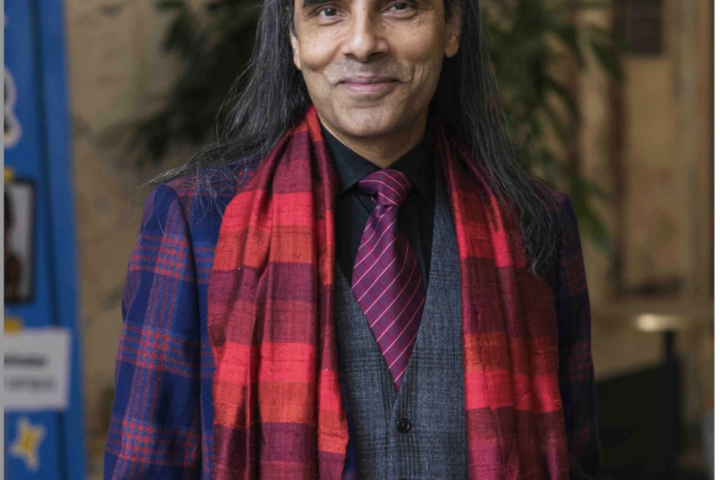
Farhang Morady, Associate Professor in International Development, School of Social Sciences; Founder and Director of the Democratic Education Network, University of Westminster, London, United Kingdom
Part of the Inside Westminster anniversary series marking ten years of the Democratic Education Network.
* * *
How did DEN begin? What was the immediate problem you were trying to answer for your students?
DEN began, in the way most quiet things begin, out of my own biography. I grew up in Iran in the 1960s and 70s, in a poor, illiterate family from Iranian Azerbaijan, settled in Tehran. I was educated in inner-city schools with large classes and inadequate resources. I came to the United Kingdom at a young age, soon became a refugee, and only later, as a mature student, could I consider enrolling in higher education at North London University (now London Metropolitan University), an institution very similar to Westminster.
Everything I have come to believe about teaching came together after completing my PhD. Once I began teaching, and because of my own history, it became natural to me that education should be compassionate and relevant to the student’s life. The classroom is not a place where knowledge is transferred, but a place where a community learns to think together and to learn from one another.
When I first started teaching, as a visiting lecturer in inner-city institutions in some of London’s most disadvantaged areas, I could see my own younger self in many of my students. I could see the barriers they faced, because I had faced them. I began thinking about how to make an impact by engaging students in what they are passionate about and, from there, developing the knowledge and skills they need to address the issues they face as individuals, within their families, and in their communities. I worked on various extracurricular projects for several years before DEN.

In 2016, the conversation that became DEN began with three colleagues: Ricardo Blaug, who had experience with a student-oriented project at the University of Leeds; Andrea Montalvo, a former student of mine; and Dibyesh Anand, then Head of Politics and International Relations. Together we applied for foundation funding from the Quintin Hogg Trust, associated with the University of Westminster, which we secured that same year. Ricardo has since retired, and Andrea moved on to a new position at the American University. DEN carried forward with the students and colleagues who followed.

Most students at Westminster came from a wide range of ethnic backgrounds, many of them children of refugees from conflict zones such as Ukraine, Afghanistan, Iraq or Iran, from working-class families in the UK, or the first in their families to enter university. We hoped to foster connections among these students, their communities, and international partners. While studying for their degrees, students hardly ever brought their own lives into the room. There was hardly any engagement between this great city, with its diverse ethnic groups, and the University. We wanted to build a bridge between the two through the students, by encouraging them to participate in extracurricular activities that let them contribute to the daily life of the University, and by being patient enough to listen to their voices.
Through my education and my own history, I have learned that a student’s potential shows up in what they can do with others, not in what they can produce alone, and that a student is not the recipient of knowledge but a co-investigator, developing relationships in dialogue with other students and with the lecturers. We wanted to build a space where those ideas were not chapters in a book but the daily practice of a room. That is what DEN is, and that is what I envisioned.

Which DEN activities across the decade stand out for you?
I have enjoyed every project that students have drawn me into: organising the weekly meetings, listening to them, and working with them to develop their stories for the online magazine, their chapters for the annual book, the summer school, and the International Student Conference. Although we hosted our first International Student Conference in 2017 at Westminster, students and I had been attending conferences together long before that. Since 2017, we have hosted one every year, with the tenth to come. After that first conference, with the help of a colleague from an international partner university in Turkey, we trained the students in editorial skills and published the proceedings. We have published one book every year since. Eight so far, with the ninth in production. That the students edit each other’s work, and that the process is genuinely mutual, is the part that matters. The books are how a community teaches itself to be a community.
The second is the field trips, and the module they became. With colleagues in Turkey, I designed a four-day field trip to Istanbul, which was as much about the local Turkish community in London as it was about Turkey. We ran the first two trips without any University funding: students paid their own flights, and the Turkish partner university covered accommodation, transport, and some food. The impact on the students was disproportionate to the trip’s length, so we built the field trip into a second-year undergraduate module, Learning in an International Environment, with optional trips to Turkey, Vietnam, and India. That is the pattern DEN has repeated ever since. A student experience becomes a curriculum, and a curriculum becomes an invitation to more students.

It has also been a pleasure to work with communities in London. With one of my former students, I arranged for undergraduates to tutor recent immigrants seeking asylum in literacy and numeracy. We then collaborated with teachers from the Horn of Africa, and Westminster students began mentoring secondary school pupils from East African communities in London. Later, we developed an exchange with City and Islington College, and in 2019, the BTEC students presented a paper on artificial intelligence at our International Student Conference. These are the projects I am proudest of, because they best answer the question the whole of DEN was designed to answer: whose voice belongs in the room.

Was there a moment at DEN that has stayed with you?
There have been so many students in the last decade that it would take several books to write about them all.
Hearing students’ life journeys, from the UK, Afghanistan, Iraq, Turkey, Ukraine, the USA, Africa and beyond, and how they have had to deal with issues that many times were not of their own making. Hearing them speak about it at DEN’s meetings and then writing and sharing those journeys with others has been one of the best gifts I have received in my life. The trust built in the community must be earned, and the way and why you share it are very special. I am always grateful for the students who share their thoughts and their past and present journeys.
What aspects of DEN have had the biggest impact on you?
The community, and its ordinariness. The Wednesday afternoon rhythm. The students who show up because they want to. The alumni who come back years later without being asked. The colleagues who arrive out of curiosity and end up building a module. The visiting scholars who thought they were coming for a fortnight stayed for years. None of it depends on my presence in any single meeting, which is the truest measure that we have built something worth building.

Since I have been a lecturer, I have learned, mainly from my students, that the teacher’s job is to build a room in which the material can be discussed democratically, with respect, and with trust that we are all trying to make this world better. This cannot be only in theory. Practice matters as much. The difference between the two, and the application of both together, is DEN.
How has DEN influenced your teaching, your research, or the way you think about working with students?
DEN and my teaching have never been separable. Although DEN runs entirely on volunteer time, the students have shaped my approach, my practice, and my understanding of what they need from a university.
My research has followed the same path. Alongside my own work on Iran and on international political economy, which I continue, I have made sure that students collaborate with academics on the writing and publication that a university would otherwise ask them to wait years to attempt. My most recent editorial work, the two forthcoming volumes with Edward Elgar and Emerald, and the volumes already published through IJOPEC, all sit at the intersection of education, sustainability, and the political economy of the Global South. That is where DEN has pushed my writing. DEN has shown me that the way we teach is itself a political economy, with its own inequalities and its own possibilities.
Has DEN supported your academic career or professional development?
What DEN has given me, in institutional terms, is easy to list, though I set it down here reluctantly. Every line of it belongs, first and foremost, to the students and to the colleagues at Westminster and internationally who have made this work possible.
Through my work with students, I was awarded the National Teaching Fellowship in 2022. Highly Commended at the European Green Gown Awards 2025 in the Student Engagement category, and a Finalist place in the Staff Sustainability Champion category the same year. The Guardian University Awards runner-up recognition for Student Experience in 2019. An invitation to become a Visiting Professor at Hanoi University since 2022, and a Distinguished Scholar at Kasetsart University in Bangkok for 2026 to 2027. International partnerships in Vietnam, Turkey, Thailand, Peru, Uzbekistan, Georgia, Mexico, and beyond. The edited volumes, the journal editorial roles, the invitations to keynote in Batumi, Istanbul, Bangkok, and elsewhere. The Vietnam Ministry of Education and Training-funded research project on AI and language education that I am collaborating on for 2026. If I list it all, it looks like a career.
But the time spent working with students, seeing them develop, learn, share together, and make an impact on each other and on the community, has been a huge pleasure, one that I could not have imagined.
What is one thing DEN has given you that you would have struggled to find elsewhere?
The joy of learning, sharing, and making an impact with a group of students. The students who become alumni, colleagues, co-authors, and lifelong companions in a shared project. That is not something a university career, on its own, is designed to give you. It is what a patiently built community gives you as a by-product of the work. I did not set out to find it. I set out to build a room with one or two students. It turned into friendships where they could walk through the door, trust each other to speak their minds, and build a different world.

What advice would you give to students and to colleagues thinking of joining DEN?
To students: come once. Sit in the back. Do not speak if you do not want to. Watch the room. If, at any point in that first hour, you feel that the people in it are listening to each other in a way you have known and enjoyed before, come again. If you feel you have something to say and no one will interrupt you when you say it, come again. You do not need to be in your first year, nor do you need to be studying politics. Some of the students who have shaped DEN the most were in their final year, or studying Medical Sciences, Biomedical Science, or Law. Your voice belongs in a room like this. That is the whole invitation.
To colleagues: join one of our meetings, observe and listen to the students, and take notes. You will discover they will do more of the work than you expected, that they will do it better than you expected, and that your own teaching will change because of what you watched them do. DEN sits between disciplines and pulls people through them. Come to a Wednesday. See what happens.
What would you say to a colleague at another university?
DEN, as a project, has not been replicated anywhere yet, but its impact is already evident in places such as Tashkent, Hanoi, Kasetsart, and Istanbul. No model should be taken as it is, without careful consideration of the institution receiving it, its culture, and its approach to education. So our relationships with partner universities have grown as relationships of mutual learning and sharing, not as an exported template.
I see DEN’s influence when I visit Hanoi University or Kasetsart in Bangkok, in the way our partner students take part in conferences and publications alongside ours. But I also see the reverse. DEN has learned from what our partners have shown us. If a colleague at another university asked me whether DEN could be built there, I would say the same thing I would say to a student. Come to a Wednesday. See what happens. Then build the version that fits your own room.
Should DEN do anything differently in the next decade?
Three things, and I say them as the person who will have to lead on them.
First, DEN cannot depend on any one person, and it certainly cannot depend on me. We need a structure that survives my eventual retirement, and we need to build it while I am still here to help. That means investing in the alumni, in the junior colleagues who have grown up inside DEN, and in the students who will be running it in 2036.
The second is visibility inside the University of Westminster itself. Several students in this anniversary series, including those in Medical Sciences and others in Life Sciences, told me they only found DEN in their second or third year. That is a failure of internal communication, not of the network itself. We need to be present at Open Days, at the freshers’ fair, at induction, and in every School, not only in the Social Sciences.
The third is the digital and AI question, which the students are already ahead of us on. In September, we begin a collaborative project on impostor syndrome as one strand of this work. But this is only a beginning. The larger question, of what democratic education means when so much of a student’s intellectual life now happens in dialogue with a machine, is one DEN needs to take seriously in the coming years, and one I expect the next generation of DEN students to lead on more than I will.
Anything else you would like us to know?
DEN has been built by the students at Westminster, by the partner institutions, and by the support staff whose work makes every conference and every book possible. I am the founder and remain its director, but I am just one name on a very long list. The anniversary is a chance to thank everyone on the list. I would like this interview to be read as the first sentence of those thanks.
* * *
“Whose voice belongs in the room. That is the question the whole of DEN was designed to answer.”
* * *
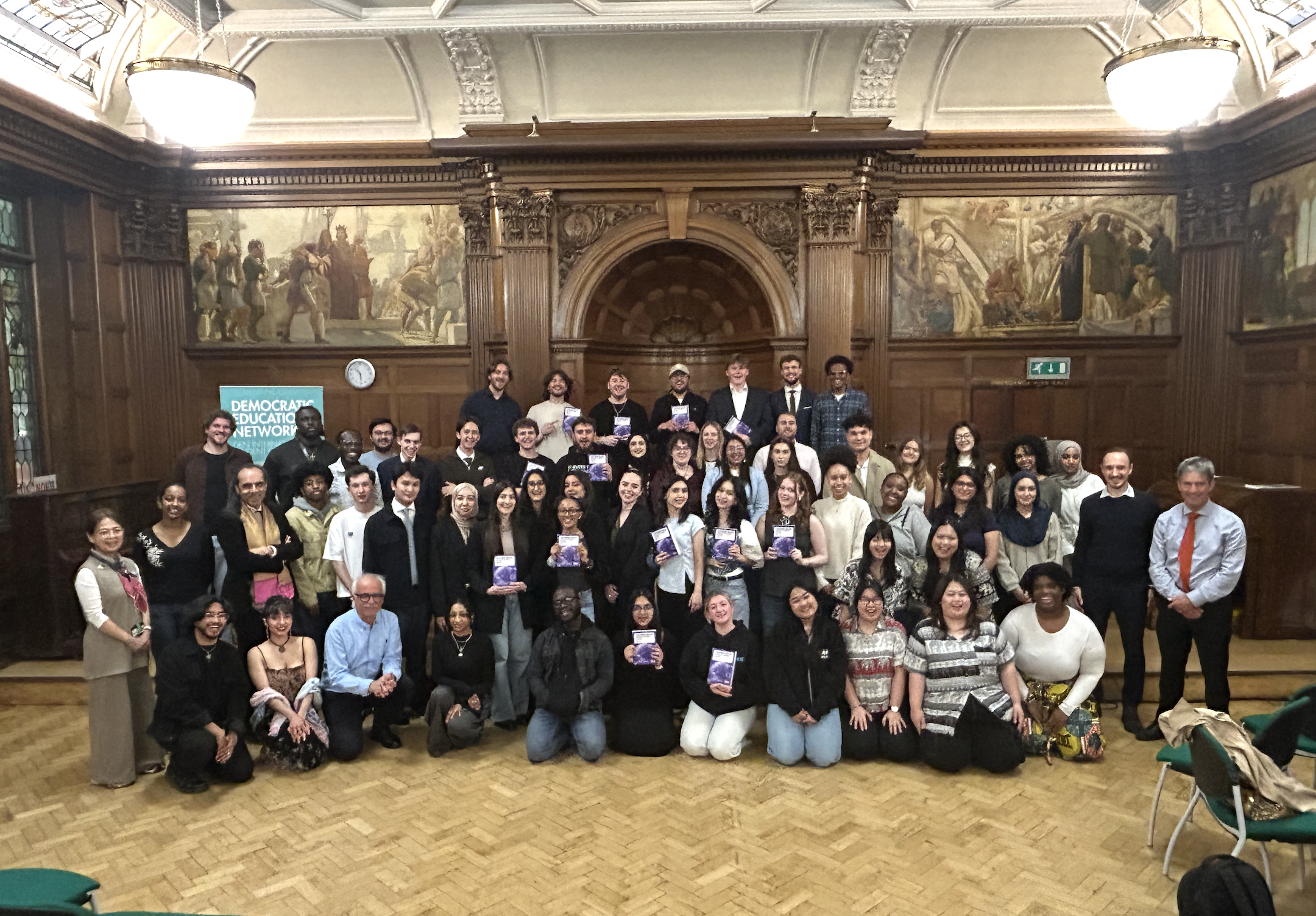
Photo caption: “Come to a Wednesday. See what happens.”