
By Tristan Kovats, History & Politics, University of Westminster
Introduction
On 12 April 2026, Hungarians turned out in record numbers: a 79% turnout, the highest since 1990. For the first time in more than a century, no party of the left won a single seat in the National Assembly. The Democratic Coalition, the last major left opposition, polled barely 1%. The current parliament represents only three parties: Tisza, Fidesz and MHM (Our Homeland Movement), all of which sit on the right of the political spectrum.
How does a prominent political tradition vanish from parliament? The answer lies in a more complicated history, beginning in the 1990s. The left’s collapse became a structural problem, rooted in its abandonment of the very ideas it was meant to represent.
Post-Socialism
With the collapse of the socialist system in 1989, strong anti-left sentiment was already appearing across institutions. The so-called “Socialist Party,” bearing only the name of its heritage, won power three times up until 2010. During its terms in government, mass privatisation began, with key state assets such as gas, electricity and heavy industry sold to Western companies.
This was followed by the 2006 Őszöd scandal, when a secret speech by Prime Minister Ferenc Gyurcsány was leaked, exposing that his government had lied “morning, noon and night” about the economy. Austerity, mass protests and a coercive police response followed, destroying the left’s claim to both competence and moral authority. When Fidesz swept to power in 2010 with a two-thirds constitutional majority, the so-called Socialist Party recorded its worst result since 1990, and its liberal partners disappeared entirely.
Electoral Alliances
What followed revealed the depth of the structural failure. Between 2010 and 2022, the opposition tried nearly every conceivable strategy, and every one failed. The Unity Alliance of 2014 combined the socialists, the liberals and the newly formed parties of the post-2010 generation. Yet it won only 26% of the vote, a result seen as a crushing defeat precisely because it had pooled every anti-Orbán vote available. The 2018 coalition added the formerly far-right Jobbik to the mix. The 2022 “United for Hungary” went further still, uniting six parties behind a single prime ministerial candidate.
Each experiment confirmed the same finding: Hungarian voters were not refusing to coordinate against Orbán; they were refusing to coordinate around the remnant of the pre-2010 governing class. The left’s brand had become the problem itself.
Fidesz
Meanwhile, Fidesz was quietly completing the left’s displacement. Its “System of National Cooperation,” the rewritten constitution, the subordinated media and the electoral rules that reliably converted pluralities into supermajorities are all well documented. Less appreciated is the ideological colonisation beneath it. Through utility price cuts, thirteenth-month pensions, workfare programmes and family benefits, Fidesz addressed the material anxieties of precisely the working-class and rural voters the so-called Socialist Party had spent the 2000s ignoring. Orbán did not merely defeat the left electorally; he absorbed its social function, leaving the opposition parties to compete over an ever-narrowing urban, educated electorate while their historic base drifted towards Fidesz or into abstention.

The Rise of Tisza
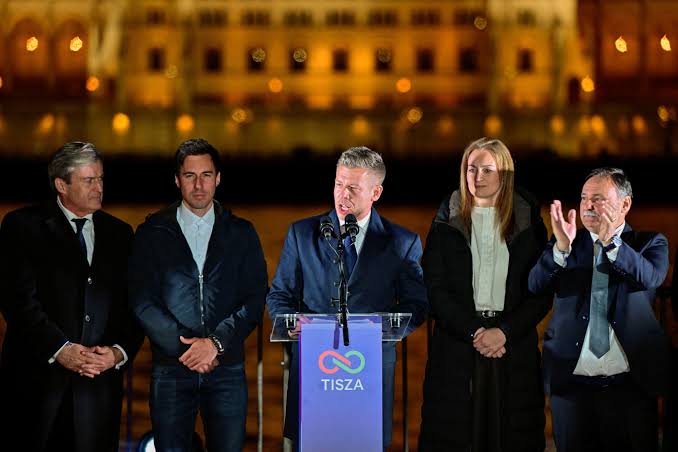
In February 2024, Péter Magyar, a career Fidesz insider, former diplomat and state bank executive, broke with the party amid a presidential pardon scandal, accusing the government of systemic corruption. He then took over a dormant party, Tisza (short for the Respect and Freedom Party). In economic and social policy, Tisza sits closer to the centre-right. Even so, its strategy rejected the left-right axis altogether, focusing instead on anti-corruption, alongside EU reorientation and welfare investment in health and education, while retaining nationalist positions that made former Fidesz voters feel welcome. Within months, Tisza was polling above every opposition party. The left responded by capitalising on its rise, and by 2026, even the Socialist parliamentary leader was urging supporters to vote for Tisza.

Conclusion
So what does it mean when an entire political tradition disappears? In Hungary’s case, electoral defeat was only the visible symptom. The left died much earlier, when it ceased to represent the class whose name it carried, and when its adversaries, first Fidesz and then Tisza, built their victories on that abandoned ground. Whether anything worthy of the name “left” can still be reconstructed remains an open question of the post-Orbán era.



What an amazing blog! I really enjoyed reading it and learnt a lot! Thank you Tristan!
With the current polarisation of politics in general, it is interesting to see what happens electorally when there is very little trace of the common Left-Right, two-party politics divide.