
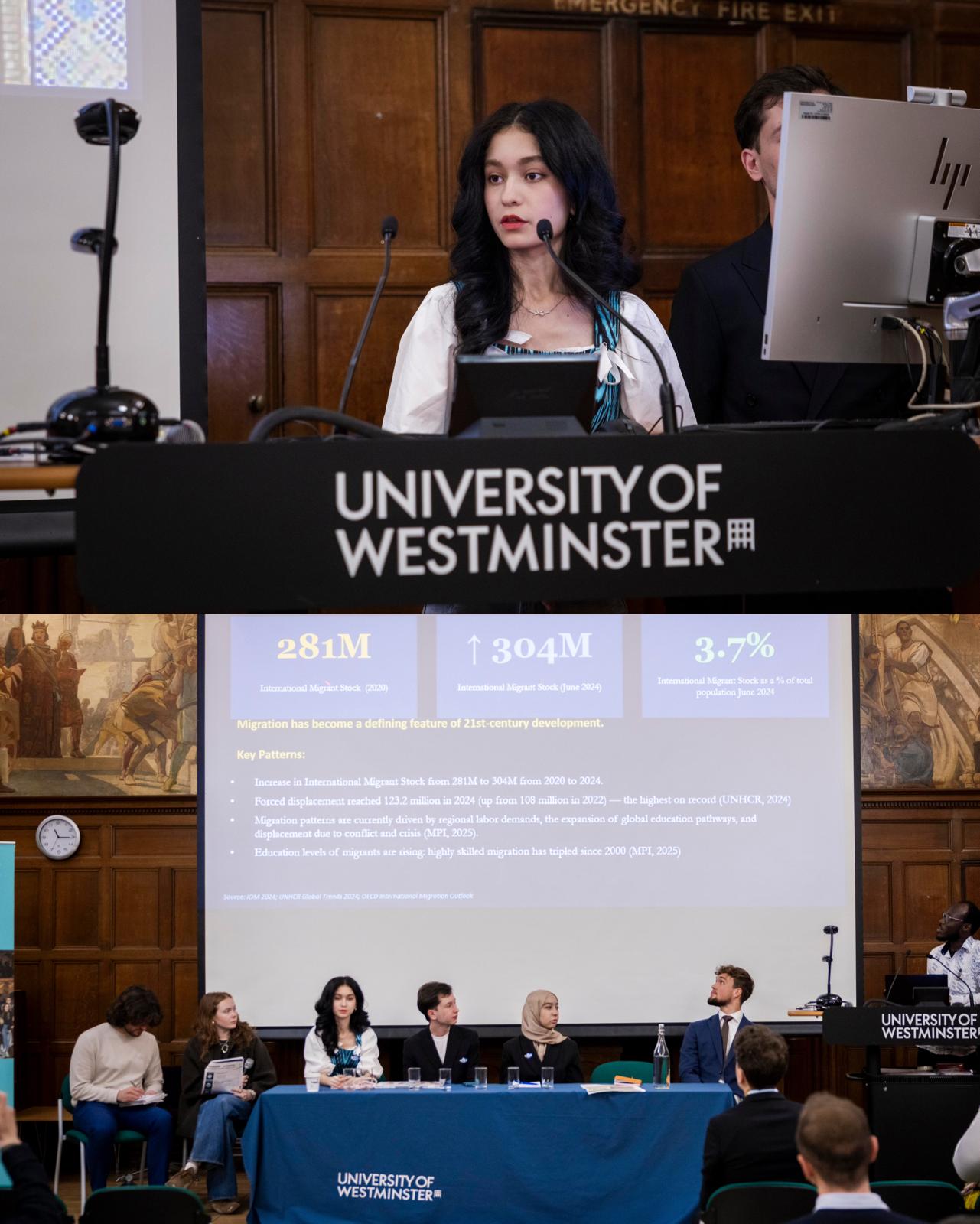
From winning WIUT’s SDG Course to hearing the Westminster Vice-Chancellor say he had just learned an Uzbek word from her presentation
Mekhrangiz Khoshimova, Level 4 BSc Business Management, Westminster International University in Tashkent (WIUT), Uzbekistan
Part of the Inside Westminster anniversary series marking ten years of the Democratic Education Network.
* * *
How did you first come into contact with DEN?
My journey with DEN began through our Sustainable Development Goals course at WIUT. Together with my team, we worked on a project under SDG 11: Sustainable Cities and Communities. After winning first place, we were invited to attend the DEN Summer School and Conference at the University of Westminster in London.
At first, I thought it would simply be an opportunity to present our work. I soon realised it was much more than that. It became a chance to meet inspiring people, to exchange ideas across cultures, and to experience what democratic education looks like in practice.
Which DEN activities have you taken part in?
The DEN International Conference 2026, and our team presentation, The Silk Road Never Ended: It Just Went Digital.
Was there a moment at DEN that has stayed with you?
One moment I will never forget happened after our presentation. We introduced the Uzbek concept of mahalla, and explained how it represents much more than a neighbourhood. It is a community built on support, belonging, and shared responsibility.
Afterwards, Professor Peter Bonfield, the Vice-Chancellor of the University of Westminster, came over and mentioned that he had learned the word mahalla from our presentation. It might seem like a small moment, but it meant a great deal to me. I felt proud to share a piece of my culture with people from different parts of the world.
More importantly, I realised that the conference itself reflected the meaning of mahalla: people learning from one another, exchanging ideas, and building connections through mutual respect.
What aspects of DEN have had the biggest impact on you?
The people. Meeting students from the UK, Poland, Thailand, Serbia, Uzbekistan and other countries reminded me that although we come from different cultures, many of us care about the same issues and hope to create positive change.
I also appreciated that every student was treated as someone whose ideas mattered. It never felt like students were simply presenting to academics. It felt like we were contributing to a genuine conversation.
How has DEN helped you develop personally?
DEN made me more confident in sharing my own ideas internationally. Representing Uzbekistan in London reminded me that our stories, our culture, and our perspectives deserve to be heard.
It also encouraged me to become a better listener. Some of the most meaningful learning happened while listening to other students speak about experiences completely different from my own. One presentation that deeply moved me was Negena’s, on girls’ education in Afghanistan. Listening to her made me realise how fortunate I am to have access to education and opportunities that many girls around the world are still denied. It reminded me never to take education for granted.
Has DEN helped you with employability or professional development?
Absolutely. Presenting research to an international audience strengthened my public speaking and communication skills. Working alongside students from different countries also improved my teamwork and intercultural communication.
Most importantly, DEN showed me the value of collaboration. Some of the best ideas come from people with completely different backgrounds, and learning how to work across cultures is a skill I know will benefit me throughout my career.
What is one thing DEN has given you that you would have struggled to find elsewhere?
A genuine sense of belonging within an international academic community. DEN was not simply about attending lectures or giving presentations. It created a space where students could learn from one another as equals. That feeling of openness, trust, and mutual respect is something I have not experienced in many other educational settings.
What advice would you give to students thinking of joining?
Say yes. Do not worry about having the perfect presentation or knowing all the answers. Be curious, ask questions, talk to people, and listen carefully to their stories. You will probably leave with much more than you expected.
What would you say to a colleague at another university?
DEN is not simply a conference or a network. It is a community. If your goal is to create an educational environment where students genuinely learn from one another, share ideas openly, and build international friendships, then DEN is an excellent example of how that can be done.
Should DEN do anything differently in the next decade?
I hope DEN continues expanding its international partnerships, and reaches even more students from different parts of the world. If I could suggest one thing, it would be to create more opportunities for alumni to stay involved after participating, so that the connections and the conversations continue long after the conference has ended.
Anything else you would like us to know?
Looking back, DEN gave me much more than an international experience. It gave me friendships, confidence, and a new perspective on education. It reminded me that education is not only about gaining knowledge. It is about sharing it, listening to others, and growing together. I left London with memories I will always treasure. More importantly, I left believing even more strongly in the power of young people to learn from one another and to create meaningful change.
* * *
Photo caption: Representing Uzbekistan at the DEN Conference reminded me that every culture has a story worth sharing, and every student has a voice worth hearing.

That’s a fantastic way to describe it – the sense of community and shared experience really does feel like a mahalla.