A final-year Medical Sciences student on impostor syndrome, the presentation that surprised her, and the DEN project that has grown from it
Rida Butt, BSc Medical Sciences, final year, University of Westminster, United Kingdom
Part of the Inside Westminster anniversary series marking ten years of the Democratic Education Network.
* * *
How did you first come into contact with DEN?
I first came across DEN through an email inviting students to submit an abstract for a conference presentation. I wanted to push myself outside my comfort zone, so I decided to submit an abstract on something I had struggled with for most of my life, and something I am still working through today: impostor syndrome.
I was quite hesitant to join a new community. I was nearly at the end of my second year, and I kept wondering whether it was too late. Outside my Life Sciences cohort, I barely knew anyone, and I questioned whether I was doing the right thing. After speaking to my mum, she encouraged me to go for it.
On the day of my presentation, part of me wanted to leave, because I did not feel capable of standing in front of everyone and speaking. Then I realised the irony. I was giving an entire presentation about impostor syndrome, while allowing my own impostor syndrome to convince me that I should not be there. How could I give advice to others if I was not willing to take that advice myself? So I encouraged myself: if I am here, in this hall, I have a purpose.
The DEN community does not focus on who you are, where you come from, or whether you think you are the “right” person to be there. As students, we can sometimes feel as though we are simply expected to follow the structures already in place. But where do our opinions go? Do they stay in our minds, or are we given the opportunity to express them, to question things, and to contribute? DEN gave me that opportunity. What started as me trying to step outside my comfort zone became a space where I realised that my experiences, and my voice, could actually have value.
Which DEN activities have you taken part in?
I have taken part in a DEN conference, where I presented my work on impostor syndrome. From September, I will also be starting a collaborative project exploring impostor syndrome further, and I will be taking part in regular DEN meetings as part of that work.
Was there a moment at DEN that has stayed with you?
One piece of feedback at DEN that stayed with me was hearing that multiple students had spoken afterwards about how much my presentation on impostor syndrome resonated with them. That was when it struck me. This was not just my own struggle. So many others experience it too, but deal with it silently. It made me realise how important it is to create spaces where these experiences can be openly discussed, and it is what inspired me to develop the topic further as a collaborative project.
What aspects of DEN have had the biggest impact on you?
It was the sense of community and belonging that had the biggest impact on me. What stood out first was that I never really felt a power gap between students and academics. Everyone could contribute, speak openly, and learn from one another while still maintaining mutual respect. It creates an environment where you can mix with people quite easily, regardless of whether you joined DEN in your first year or even towards the end of your degree. I joined relatively late in my university journey, but I never felt as though I did not belong.
How has DEN helped you develop personally?
I was never someone who enjoyed presenting, and initially, I took part in the conference simply to push myself and expand my skills. However, after presenting at DEN, I realised that I do quite enjoy presenting, and it has given me a new sense of confidence, and even helped solidify the direction I want to take with my future career. Since then, I have actively looked for more opportunities to use my voice, including taking part in student workshops and discussions about teaching, learning, and how the university experience can be improved.
Has DEN helped you with employability or professional development?
DEN has helped me develop skills that I know will be valuable in my future career, particularly presentation, communication, and research skills. I am interested in pursuing a career within the pharmaceutical industry, where being able to communicate scientific information clearly to different audiences is extremely important.
While researching and presenting my work on impostor syndrome, I had to take information, research, and statistics, and turn them into something accessible to students from non-scientific backgrounds. This strengthened my ability to identify important information, interpret it, and communicate it without assuming that the audience already has specialist knowledge. I also picked up techniques from my research on impostor syndrome that I have been able to apply to myself, which has helped with my own professional development.
What is one thing DEN has given you that you would have struggled to find elsewhere?
DEN has given me a judgement-free zone to practise speaking out, before stepping into the wider professional world. I genuinely believe that you cannot lose from being part of DEN. You can only gain. You gain experience, confidence, connections, new perspectives, and most importantly, a voice.
University can sometimes become very focused on your own degree and your own routine, and it is easy to go through each day without really knowing what is happening beyond your own subject area. DEN has allowed me to connect with people outside of Medical Sciences and to hear perspectives that I might never otherwise have discovered. Being surrounded by people from different subject areas, backgrounds, and experiences has encouraged me to look at issues from more than one angle, rather than only through my own lens.
What advice would you give to students thinking of joining?
Do not be afraid to take a leap of faith. If you are not comfortable presenting, present. If you are nervous about joining a new community, join it. Sometimes the opportunities that make us the most uncomfortable are the ones we gain the most from. DEN has taught me to embrace that discomfort, because that is often where the most growth happens.
What would you say to a colleague at another university?
I would tell them that DEN is something I wish existed at every university. From what I know, I have not seen another initiative quite like it. The University of Westminster has created something that goes beyond academics. It gives students a genuine platform to speak and connect with people from across the university.
Should DEN do anything differently in the next decade?
I would love to see DEN advertised more widely across the university, particularly to students in Life Sciences and other disciplines who may not have the chance to come across it. I only discovered DEN towards the end of my second year, and I think making it more visible and more accessible across different subject areas would allow even more students to benefit from the community.
Anything else you would like us to know?
I am extremely grateful to have been given the opportunity to be part of DEN, and I am really looking forward to becoming even more involved from September.
* * *
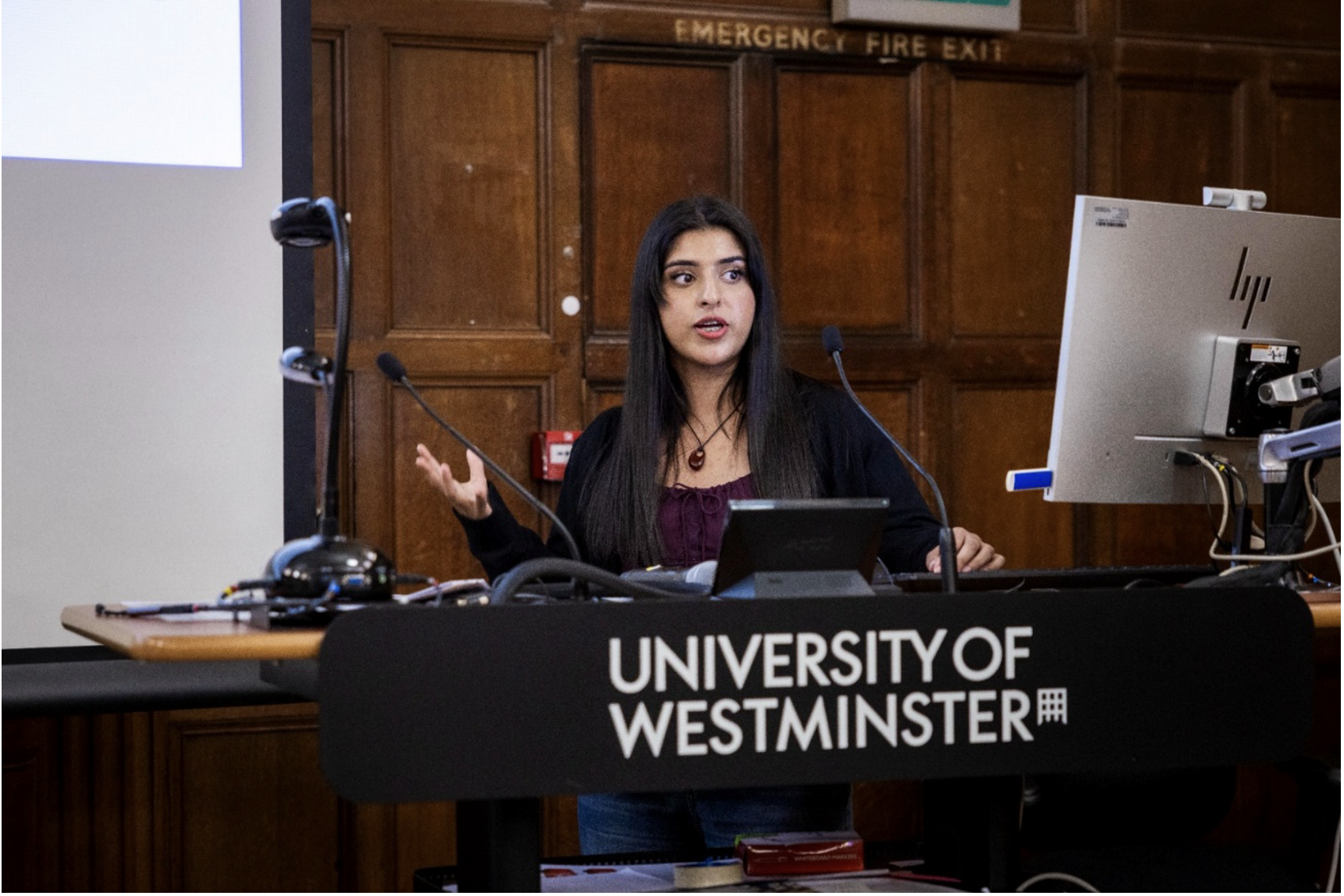
Photo caption: Rida Butt presenting on “Impostor Syndrome in Higher Education” at her first DEN conference.