A teacher’s reflection on the SOC-ENVI Kasetsart International Summer School 2026.
By Dr Farhang Morady · Director, Democratic Education Network, University of Westminster. Distinguished Scholar, Kasetsart University.

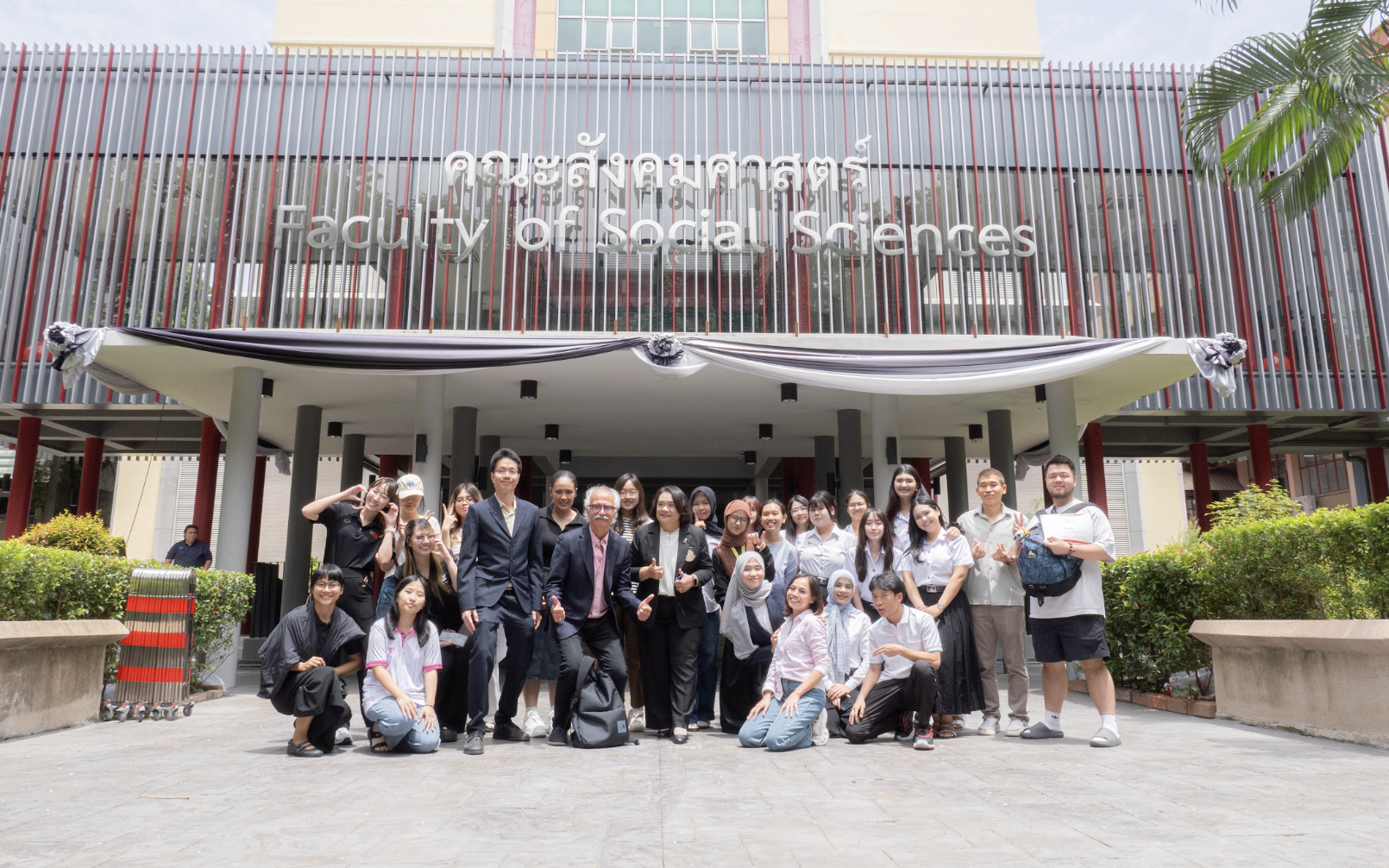
Caption: The Kasetsart Summer School cohort, Faculty of Social Sciences, July 2026.
I delivered three lectures over the fortnight in Bangkok and read ten reflections when the students went home. Somewhere between the first slide and the tenth blog, the teacher-student direction quietly reversed. This is what my students taught me back.
Before we arrived
Weeks before Bangkok, we gathered on a screen. I opened with one question I hoped would carry the fortnight: “What did the last 24 hours of your life have to do with someone you have never met on the other side of the world?” The room went quiet, then hesitant, then generous. Nobody answered it neatly. Bernaflor would later give me back my own question with a better answer than I had: “We live in a shared world.”
The pleasure of the room that arrived
When we finally sat in the same classroom, different countries and cities were in the room with us: Palembang and Bogor, Beijing, Hanoi, Manila, Bangkok, London and Hong Kong. Each student had brought their place with them. In the discussions, they pushed back with care and built on each other’s arguments faster than I could keep up with. Adinda made me think about language as an economic institution. Wan Tim about solitude as infrastructure. Tri about the Musi River as an accounting problem. Ha Chi about the butterfly effect as pedagogy. I arrived to teach, and I left with a notebook full of ideas the students had lent me.
 Caption: The cohort in the Faculty of Social Sciences, mid-fortnight.
Three lectures, one direction
The three lectures moved from global frameworks to a glocal practice, and finally to what it means to become a changemaker. But the sessions I remember are the ones in which I stopped talking. When I asked, they answered. When I gave them a case, they returned a sharper one. The classroom kept becoming a place where none of us was quite the teacher, and none of us was only the student.
What Phetchaburi taught us
I was not on the bus that took the students to Phetchaburi. But the field trip returned to Bangkok in their faces the next morning, and later in almost every one of their reflections. On the day at the LERD Project, they walked through mangroves being used to treat wastewater, visited a crab bank and a sea grapes farm, and spent an afternoon in one of the small villages that live on a sacred river. What they brought back was not new to any textbook, but it lands differently in a mangrove than it does in a slide: sustainability is not a policy imposed from above. It is a practice grown from below, held together by community trust, and made durable by the smallest, most locally rooted acts.
 Caption: The LERD field trip, Phetchaburi Province, July 2026.
Reading their reflections
The Summer School did not end for me when the students flew home. It ended slowly, as each reflection landed in my inbox. Reading them was one of the great pleasures of my summer. I read each piece twice, once for the argument and once for the voice. Each of the ten taught me something I had not brought to the fortnight myself. Elaine on trust in water. Tri on cheap and lasting solutions. Ha Chi on how the smallest change is never small. An on the courage to speak. Dwi on leadership that begins with listening. Njayl on friendships that outlast the fortnight. Wan Tim on solitude as a gift. Adinda on language as people. Kayyisa on closed doors becoming open windows. Bernaflor on preventing harm by considering another. Ten writers. Ten arguments. One shared world.
“Ten writers. Ten arguments. One shared world.”
Education is not only about the mind
If there is one thing the ten reflections taught me collectively, it is that education is never only about the mind. It is also an emotional event: the worry of a new place, the wobble of the first shared meal, the fear of not quite fitting in, and the small courage it takes to speak first. Almost half the blogs used the phrase “comfort zone”, and it is the phrase I want to end on.
A comfort zone is really the edge of an unknown territory. What we learn when we cross it is how to explore, adapt, and be present together, with respect for each other. The field trip made the same point in a different key: at the heart of any unknown territory is the natural art of human relations, and this fortnight demonstrated it in both theory and practice.
Keep the network warm
Send each other a message on a slow Sunday. Read each other’s blogs. Suggest each other for opportunities. When you next travel, host each other. Networks decay quickly if left alone, and yours has been paid for with real time and real feeling. Thank you, all ten of you, for being the students you were, and for teaching me things I did not know before you walked into the room.
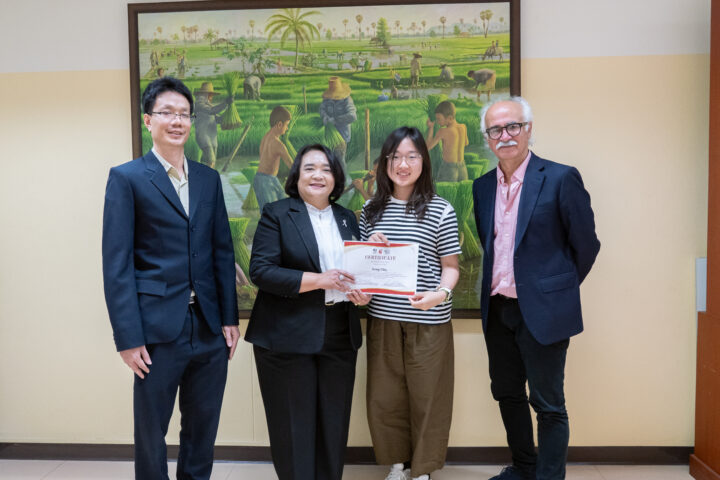
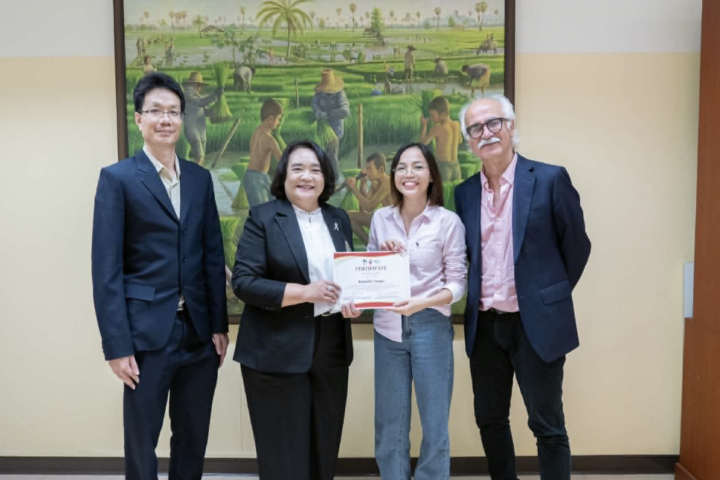
My warm thanks to Dr Korakit Choomgrant for shaping and leading the Summer School, and to Kwanumas Suddepong (Cartoon), whose behind-the-scenes work on logistics made the whole fortnight run smoothly. And my warmest thanks to Prof. Dr. Ngamlamai Piolueang, Dean of the Faculty of Social Sciences at Kasetsart, whose welcome and whose backing of the programme made all of it possible.
 Caption: Certificate ceremony, closing day at Kasetsart University.
About the author
Dr Farhang Morady is Director of the Democratic Education Network at the University of Westminster, London, and Distinguished Scholar at Kasetsart University, Bangkok. He is the editor of the forthcoming DEN volume “The Future of Sustainable Development in a World Beyond the UN SDGs” (in press 2027).