

A reflection on language, listening, and what makes change take root, from the SOC-ENVI International Summer School 2026.
By Adinda Avrora · IPB University, Indonesia.
The SOC-ENVI International Summer School 2026 was hosted by the Faculty of Social Sciences at Kasetsart University, Bangkok, in partnership with the Democratic Education Network at the University of Westminster, London. It ran for a fortnight in July 2026 and brought together undergraduate and postgraduate students from the Philippines, Vietnam, China, Indonesia, Thailand and the United Kingdom to work on sustainability, social innovation and community-based development, in the classroom and in the field.
One line from a friend, spoken in ordinary conversation, gave a name to something I had carried long before I had the words for it. Two weeks of listening across five countries taught me that sustainable change is not first a matter of systems, but of the ground on which people stand.
A friend’s throwaway line
“Language is people, people is language.”
I thought this was a famous quote when I first heard it. It sounded like something I had encountered in a book, a lecture, or perhaps a philosophy class. Later, I found out that it was simply something my friend said to me during our Summer School at Kasetsart University, in Thailand. It was one sentence, spoken in an ordinary conversation, yet it articulated something I had carried long before I had the words for it.
I have always found people easier to approach through their language. Not because vocabulary is a map of a person, but because it is one of the first doors they leave open.
The simplest questions: how do you say hello?
In Thailand, I began with the simplest questions. How do you say hello? How do you address people? I asked my friends for the words they used naturally, and I tried to return the gesture by teaching them mine. Soon, language became less about learning how to speak and more about learning how people locate themselves in relation to one another.

Caption: Brainstorming mindmaps for a shared issue of air pollution.
The courage of speaking badly
There is a certain courage in speaking another person’s language badly. We have to accept being unfamiliar. We have to allow ourselves to mispronounce, to ask again, to be corrected, to laugh at ourselves when we accidentally say a bad word. Perhaps that is why language became my way of approaching people. It gave me permission to enter worlds that were not mine without pretending that I already understood them.
“There is a certain courage in speaking another person’s language badly.”
What people stand upon
The more I listened, the more I noticed that people carry entire philosophies in the smallest things. In the stories they tell about home, in the food they insist you try, in the way they make room for someone at a table, or hesitate before saying goodbye. In what they consider generous, rude, funny, beautiful, or worth protecting. Sometimes a person says more in a gesture than they could in a paragraph. To learn someone’s language is to become attentive to the world as they have learned to see, and to encounter the ground on which they stand.
This way of seeing people has always shaped my understanding of community.
Sustainability as relational work
Sustainability is often framed through systems: resources, infrastructure, policy, technology. Yet every system eventually reaches a human being. Someone must understand the problem, trust the solution, participate in it, adapt it to their circumstances, and persuade someone else that it is worth continuing. That is where sustainability becomes relational.
A technically sound solution can fail when people do not see themselves in it. Conversely, a small idea can travel surprisingly far when it is carried through trust and a sense of belonging. A change does not become sustainable merely because it is effective. It becomes sustainable when people are willing to make it part of their lives.

Caption: Innovation starts with listening.
Knowledge and proximity
In this Summer School, I learnt to be more attentive to small changes. The people I encountered did not give me identical lessons. They came from many countries: the Philippines, Vietnam, China, Indonesia and Thailand. They gave me fragments. A different point of view. A reminder to be present. An invitation to share. A story that remained long after the conversation ended. Our differences were not obstacles to connection. They were the reason there was something to learn.
This is what the Summer School gave me that a classroom alone could not. It made me less interested in asking, “What does this person know?” and more interested in asking, “What does this person stand upon?” The distinction matters. Knowledge can be exchanged, but understanding requires proximity. Proximity does not always mean knowing someone for years. Sometimes it is created in a conversation between classes, during a shared meal, on a trip to a village, or in the decision to remain curious when something feels unfamiliar.
“Knowledge can be exchanged, but understanding requires proximity.”

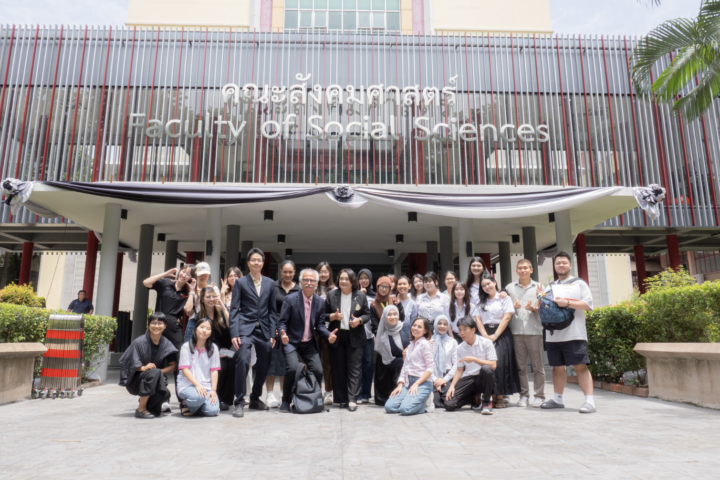
Caption: Kasetsart University Summer School 2026 — participants and lecturers.
A way of looking
I think sustainable change requires this kind of proximity. Before asking people to change their communities, we must first be willing to understand them. Before introducing a solution, we need to know what people value, what they fear losing, what they already know, and what they are capable of. Otherwise, even the most well-intentioned intervention risks becoming something done to people rather than built with them.
The most valuable thing I brought home, then, was not a particular solution. It was a way of looking.
To begin with, language. To listen for the worldview beneath it. To approach differences with curiosity rather than certainty. To believe that a small gesture can become meaningful when it is rooted in a genuine connection.
“Language is people, people is language” stayed with me because it gave a name to something I already believed in. People are not simply the recipients of change. They are where change begins.
About the author
Adinda Avrora is a student at IPB University, Indonesia. She joined the SOC-ENVI Kasetsart University International Summer School in July 2026 as part of the IPB University cohort.

What a beautiful piece of writing. We often forget to acknowledge people first before implementing new practices.