
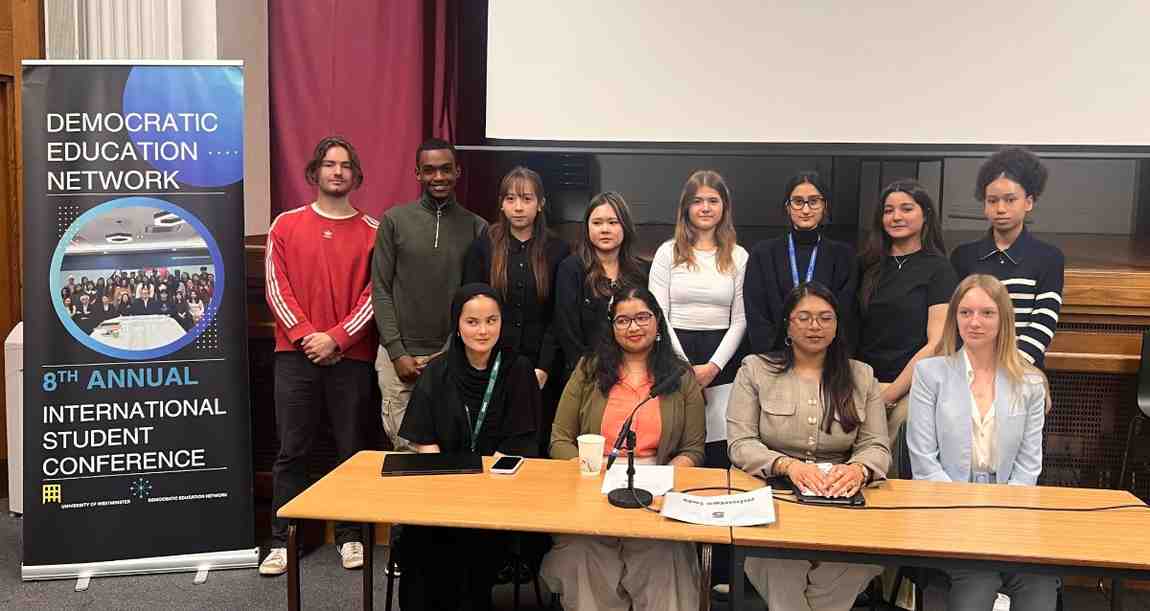
In my blog, I want to reflect on the DEN Conference that was held on the 9th of May 2025. In particular, I want to address the question of what impact my almost 8-months-long participation in DEN and the final Conference had on me and my understanding of education. I also aim to explain the parallel between my previous different educational experience and the one DEN stands on.
My first encounter with DEN was back in mid-September, when I attended a DEN welcoming event in Faiyve Hall. At that time, I was very new to the University and was trying to get engaged as much as possible – I was joining societies and attending events without knowing what they were actually about.
I don’t remember much from the DEN welcoming event, apart from meeting Farhang there and playing a very funny quiz. I got a leaflet with the information that meetings were held every Wednesday from 2pm to 4pm, so I thought why not give it a try?
I have to admit, my expectations were not very high – the name “Democratic Education Network” just did not catch my attention and, from the welcoming event, it looked more like a party than an insightful, educational initiative.
However, there was nothing to lose, so I turned up for the first meeting. My expectations dropped all the way down when I went to the supposed meeting room written on the leaflet and could not find anyone there. At the reception, they told me it was too early in the academic year and suggested that I come next week. By that point, I was seriously sceptical about DEN, and was in doubt about whether or not I should get involved, given that I had no idea what the involvement would look like.
This first, not very positive impression, DEN had on me had a significant impact on how I viewed it almost the entire first semester. I would turn up to a couple of meetings, meet with Farhang and a few other students, but was prioritising other activities.
My approach changed at some point before the Winter break and especially when Farhang expressed the possibility of organising the trip to New York City and visit to the UN. I was very interested in the trip and, as one of the first students who wanted to make it happen, I felt responsible for it and wanted to be in charge of the planning. Therefore, I started attending meetings and was surprised by discovering what DEN is really about.
What I was surprised by was not necessarily the different approach to education. I have already experienced a very similar, informal form of education in primary school – I spent my first five years of education at a small, local school, which was very different from other schools in the Czech Republic, where I grew up. There were around six pupils in class and the whole school had no more than 40 pupils. In the following years, I had not experienced this kind of education anywhere in the Czech Republic – everyone at the school known each other, the teachers treated us almost as their own children, and there was a strong emphasis on the experience of learning and on how we, as kids at the start of our educational journey, thought about it as something we want rather than the teachers or our parents wanted from us.
This early experience extremely shaped my understanding of learning. I was not doing my homework in order to get a good mark – since we were not given any marks throughout the five years at that school – I was motivated by my teacher who taught me that I must do the homework (and all other assignments) to then enjoy free time with my friends, school trips (which there were plenty of) and games which were all part of our school days, usually after lunch up until late afternoon.
Leaving the school when I was 11 years old was extremely challenging, and I experienced an utter shock after going from such a safe environment to secondary school, which was so different, and yet, it could be the model of a typical educational institution in the Czech Republic: rather big, formal and full of students with different social statuses and with little interest in learning anything.
As I moved to the UK and started my education at the University of Westminster, I was prepared to experience a shift again – not just from moving to higher education, but also to a Western country, uneffected by the commnist-era educational system and approach. This change was real, but I was able to find comfort in attending lectures and engaging in seminars, while having the majority of my mark based on individual work.
As I was attending DEN meetings more frequently, wrote my own blog and then started actively planning the trip to New York City and to the UN, I realised there are similarities between the form of education I experienced for five years in primary school, and the kind of education that DEN promotes. On the other hand, I recognised significant disparities between the usual, formal education at the University of Westminster and DEN.
I don’t believe in the existence of one, the correct approach to education. Every pupil and every student is different, and their preferred form of education (which is the one they enjoy but also through which they actually learn), will vary significantly, also based on their previous educational experience.
As I came to this conclusion, I developed a special connection to DEN – it reminds me of the time I enjoyed at primary school. The community and the feeling of belonging that makes you naturally engaged and transforms learning into something much more fun and worthy.
The DEN Conderence convinced me that drawing those parralels between my primary school and DEN was correct. And, therefore, similarly as my primary school changed me and formed me as a person, the same is true with DEN. Weekly meetings, conferences and trips, for example as the one to New York City to which I am just now on the plane to as I am writing this blog, are invaluable part of education at any stage in life.
Renata Pernegrova

navigate to these guys paycor employee login