

A reflection on Bangkok, Kasetsart, and the smallest change that turned out not to be small at all.
By Tran Ha Chi · Hanoi University, Vietnam.
The SOC-ENVI International Summer School 2026 was hosted by the Faculty of Social Sciences at Kasetsart University, Bangkok, in partnership with the Democratic Education Network at the University of Westminster, London. It ran for a fortnight in July 2026 and brought together undergraduate and postgraduate students from Vietnam, Indonesia, the Philippines, Hong Kong, China, and the United Kingdom to work on sustainability, social innovation, and community-based development, both in the classroom and in the field.
I flew to Bangkok expecting a fortnight of learning. I flew home with a question one of my lecturers dared us to hold, a project I now help lead in Hanoi, and the growing certainty that the smallest changes are never really small at all.
First impressions of Bangkok
Coming to Bangkok, my first impression was of the perfect combination of modern buildings and sacred temples that lay across the streets. Our hotel was lovely, with a view that felt like a large canvas of the neighbourhood we had landed in. It did not take long to unpack and set off to discover the street we were staying on.
There was a nice, bustling market, ringed by convenience stores. The first dish we had was chicken noodles, and to this day I cannot forget how good it was. The next day we were due at Kasetsart University, so we took an early rest.
A campus that feels like a park
Arriving at the university, we were struck by the sheer scale of the campus. Everything felt organised, and the environmental systems were carefully installed. There is a large river running through the campus, with a small waterwheel on it. Walking through Kasetsart does not feel like walking on a university campus. It feels like walking through a beautiful green park. And there is a large canteen that feels like a small food festival, where you can try almost every Thai dish without leaving the campus.
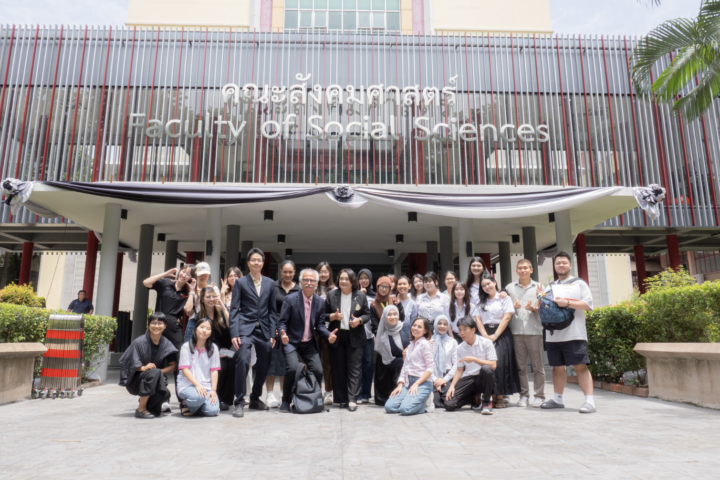
Each faculty has its own building, and we studied first at the Faculty of Social Sciences. We were grateful that all the teachers were there to give us international students the warmest welcome.
From strangers to buddies
Everyone was so warm and friendly. Even though we came from different backgrounds, from Vietnam, the Philippines, Indonesia, Hong Kong and China, we shared the same goal: to learn about development and sustainability. That shared goal made us feel less like strangers and more like old friends who had known each other for years.
From global to glocal
Our first lesson was taught by Dr Farhang, who introduced us to the ideas that would frame the fortnight: what sustainability is, what the Anthropocene means, and the difficult realities unfolding around us. Over the next few days we learned how to move from the global to the glocal, through case studies that let us talk about our own perspectives. There was no definition of right or wrong, only a chance to understand, take in, and give back.
A picture that broke my heart
We also studied at the Faculty of Environment, where we came to understand more about environmentally friendly projects that can be applied to problems many people overlook. What really touched me was the case study from Indonesia: how the coal mining industry turns a beautiful forest into a barren black landscape that would break anyone’s heart at first sight.
Beyond the lectures themselves, we were part of the teaching. Our voices were heard, and our ideas were shared and recognised.
Phetchaburi: mangroves, crabs and small changes
We also took part in a wonderful field trip to Phetchaburi, where we visited the mangrove forests and saw the LERD project in action. It showed how Mother Nature can recover herself, given the help of people who understand the biological process. A small change, sometimes the smallest change, can create the biggest differences.
After planting trees at the mangroves, we visited the crab bank and the sea grapes farm. At each place we built connections with the local people by talking with them and sharing our thoughts about the beauty around us.
A sacred river and seven villages
Later, we had a day trip to a temple with seven villages nearby, and we visited one of them. I was surprised, and moved, by how people adapt to a different way of life. The river was their friend, a sacred river that provides home, food, and protection. The houses were small and clustered closely together, neat and cosy. The people were welcoming, and introduced us to their local delicacies and their most treasured crafts. All in all, we had a lot of fun, and learned a great deal from the people at each place where we were welcomed.
The city we saw, and the lives we did not
Curiosity got the better of us when it came to seeing how geography, religion and culture shape different countries. An, another student from Vietnam, and I, together with other international students, decided to visit as many attractions in Bangkok as we could. We made use of every free afternoon and rest day, starting with the centre of Bangkok. It was a mesmerising city, with modern malls all around the sky trains, and commuting between them was easy thanks to the city’s advanced transport system.
But beyond the hustle and bustle of the city, there are still lives that remain unheard of, people who desperately need help and can only express their struggles through their eyes. They have no homes to return to, and often they are simply passed by without a second glance.
 An and I at Watarun Temple – On our free
Mr Korakit’s question
A fortnight goes by in the blink of an eye. We created memories everywhere we went, until, in one of the last sessions, Mr Korakit asked us to name one question that did not need an answer just yet, any question we were holding with us at the end of the fortnight.
In the end, I do not think any of us was brave enough to speak our real question out loud, so he told us his: “Have we truly made a difference, or have we merely been putting on a show? When we plant the mangroves, each of us can only plant one or two. Are we really making a change?”
I understood his question, and I understood the feeling behind it. If I could go back, I would try to give him my answer. I believe a change does not need to start with the visible ones. It begins within oneself, between people, and then between more people. It is the butterfly effect, and it is what we spent the fortnight learning about: the smallest change carries the largest consequences. In this Summer School we created relationships, we created a passion for change, and we created possible solutions that can be a pattern for other problems. All of these are the foundation for the “change” we say we want. It is not only about the result. It is about the courage to start doing, the process of trying, restarting, and refusing to give up, from the smallest act.
Relationships as bridges, and my first step
That last lesson was truly precious, and it has stayed with me ever since. What impressed me most was learning how relationships can create so much more than connections between people. They can become bridges, bridges for those who dare to chase their dreams, and proof of how people can support and lift one another for the better. Saying goodbye was never easy for me, especially that moment. But in our hearts, we truly believe we will see each other soon, maybe not in Thailand, but in Vietnam, in Hong Kong, or somewhere else in the world.
 A picture of everyone on our last day
A change also began within me. I have to admit that I was not very content with myself. Feeling that I was not good enough always exhausted me. I always thought I needed to improve my English, to improve my skills, to become the best version of myself before I could start doing anything. It is important to keep striving to be the best version of yourself, but it is never too early and never too late to start helping others, to take one act, one small change that contributes to something bigger than yourself. If you have read my blog from before I travelled to Thailand, I always described myself as a people-driven person. After this Summer School, I believe I am capable of much more. I am no longer shy to act on what I believe is right. A small achievement, which I truly believe is the start of my bigger journey to help others, is that I have become Event and Partnership Coordinator for our upcoming project, Local Volunteer. My small achievement after the Summer School.
The true meaning of guidance
My biggest lesson, one I believe will stay with me for life, is the true meaning of guidance. Guidance is not always about being present and teaching people who are in need, hand in hand. Sometimes, it means showing people how to help themselves without relying on the intervention of others. It is about giving people the courage to speak, to act, and to believe that they are capable of standing on their own. Most importantly, it is about being humble and understanding that, no matter what position we hold, we can always learn from one another, without letting hierarchy stand in the way.
Smallest changes, largest consequences
The SOC-ENVI International Summer School 2026 will always be a part of my journey of growth, one of the most beautiful memories that will never fade. I hope this is not where the journey ends, but where it truly begins. I want to carry the lessons, the connections and the courage I have gained with me, not simply as memories of an unforgettable summer, but as a reminder to keep learning, to keep acting, and to keep becoming someone who can make a difference in the lives of others.
Perhaps I do not yet have the answer to Mr Korakit’s question. Perhaps I will not be able to point to one visible change and say, “This is what we achieved.” But I believe that change does not always reveal itself immediately. Sometimes, it begins quietly, with a conversation, a relationship, a question, a new perspective, or simply the courage to take the first step. And perhaps, years from now, when all of us have carried what we learned into different corners of the world, we will look back and realise that those smallest changes were never small at all.
“Those smallest changes were never small at all.”
About the author
Tran Ha Chi is a student at Hanoi University, Vietnam. She joined the SOC-ENVI Kasetsart University International Summer School in July 2026 as part of the Hanoi University cohort. Since returning to Hanoi, she has taken on the role of Event and Partnership Coordinator for the Local Volunteer project.

Sounds like an incredible experience! I’ve always been fascinated by Southeast Asia and the connections you can make through programs like that.