By Tristan Kovats
Introduction
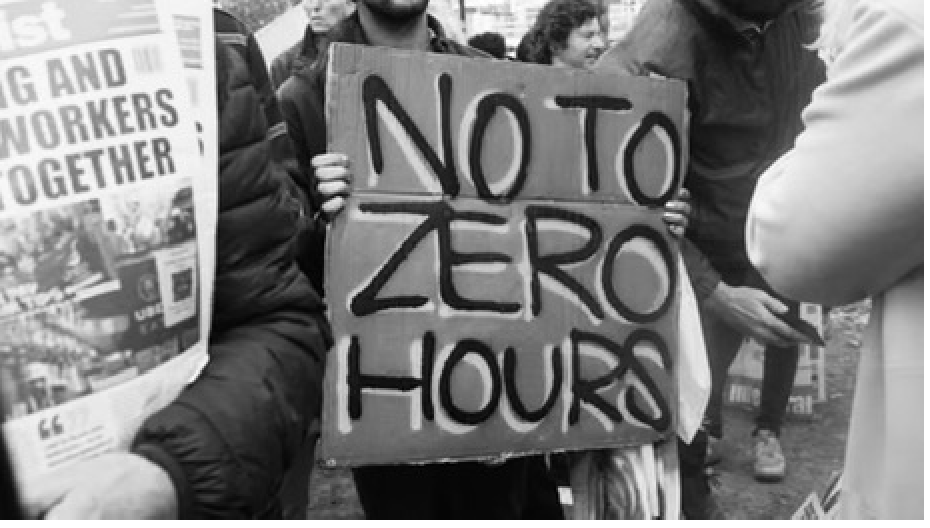
In the world’s richest economies, a society should be measured not by the wealth hoarded at the top, but by the security afforded to those at the bottom. On that measure, Britain is failing its youth. Data shows that 1.23 million people now work on zero-hours contracts as their main job, a rise of 91,000 in a single year (BBC, 2026). This reflects a labour market that has abandoned any pretence of providing security to a generation. Insecure work contracts are one of the purest expressions of capital’s power over labour: the employer holds all the cards, the worker bears all the risk, and the state looks on.
The Struggle for the Youth
The generational inequality embedded in this crisis is staggering. Workers aged 16 to 24 are 5.1 times more likely to be on zero-hours contracts than workers over 25, and one in eight young workers is on one right now.
The facts have demolished the tired defence that these contracts offer flexibility to students: 77 per cent of zero-hours workers are not in full-time education (Tribunal Claims Solicitors, 2026). These are young adults trying to build a life on a foundation that shifts beneath them every week, a generation locked out of the most basic markers of adulthood: renting a flat, securing a mortgage, planning a family. The argument that young people are refusing to work is simply untrue; it is the job market that is rejecting them. They are being absorbed into a secondary labour market designed to keep them insecure and compliant, a cheap reserve army of labour, available at a moment’s notice and dismissed without consequence.
The Cost-of-Living Trap
The damage does not stop with the young. Women make up 54 per cent of zero-hours workers, and many are mothers juggling childcare with shifts that can be cancelled at a moment’s notice (BBC, 2026). The one-sided flexibility of which the Work Foundation speaks means the worker can be summoned and dismissed with equal arbitrariness, while the employer faces no penalty for cancelling a shift and leaving a family without income (BBC, 2026). Meanwhile, the cost-of-living crisis has made this precarity lethal, and youth unemployment has climbed to its highest level in more than a decade. Having a job is no longer a reliable route out of poverty. Unreliable work lets employers socialise the risk of fluctuating demand while privatising the gains of a cheap, disposable workforce.
A Broken Job Market
The broader job market offers no sign of recovery. Graduate job postings are down sharply, and the first rung of the career ladder has “thinned” to the point of vanishing for those without connections or capital. The government’s own Budget acknowledges nearly one million young people not in education, employment or training, yet the response has been to tinker at the edges rather than confront the structural rot (HM Treasury, 2026). The Employment Rights Act promises a right to guaranteed hours, but the reforms will not take effect until 2027, a delay that leaves over a million workers in limbo while ministers congratulate themselves on legislation that has not yet arrived. This is the classic manoeuvre of acknowledging an injustice while doing only the bare minimum to keep people from resisting, something the ruling elite has done for centuries.
Defence Spending is Not a Jobs Strategy
While this economic inequality continues, the government is laying out a £298 billion Defence Investment Plan that will create “more than 60,000 new roles,” and ministers are funnelling 40,000 young people into defence apprenticeships by 2030 (GOV.UK, 2026). This is presented as a solution to youth unemployment. It is not. It is a militarisation of the labour market that channels the youth into industries whose purpose is destruction, while the civilian economy continues to be starved of the same investment. The Defence Secretary claims that “without creating good, well-paid, high-skilled jobs in defence industries, we cannot keep our country safe” (GOV.UK, 2026). But what about security for the young workers of this country? What about a guaranteed contract, a predictable wage, and the ability to plan a future? Every pound poured into military hardware is a pound not invested in the jobs that would give people a genuine stake in society.
The Need for Guaranteed Hours
The demand for guaranteed hours is not radical; it is the minimum condition of dignity. A contract that offers no stability is a licence for the employer to extract labour on demand while transferring all risk to the worker. The wage relation is a power relation, and the zero-hours contract is its most naked form. The state must legislate not merely to ban the most exploitative practices, but to establish a presumption of fixed, guaranteed hours for all workers, with full compensation for cancelled shifts and a living wage that reflects the true cost of living. Young workers in Britain are asking only for the security that previous generations took for granted, security that a government prioritising defence contracts over decent work has chosen to deny them.
Conclusion
Zero-hours contracts are not an unfortunate side effect of a modern society, but a mechanism of exploitation, disproportionately imposed on the youth, that defends employers who profit from uncertainty. The 2027 reforms may sound appealing in principle, but will almost certainly prove insufficient in practice. A right to request is not a right to have, and a policy that relies on employer compliance will fail the very workers it is meant to protect. The real solution is not more ministerial tinkering with contract law. It is a programme of public investment that creates secure, well-paid, unionised jobs for young people and families alike, funded by a reallocation of resources away from militarism and towards the social wage. Until then, a generation will continue to be told that insecurity is the price of flexibility, and that exploitation is the cost of opportunity.
References
BBC (2026) ‘Number of workers on zero-hours contracts hits record high’, BBC News, 24 February. Available at: https://www.bbc.co.uk/news/articles/czj1m7d4gxpo (Accessed: 1 November 2026).
GOV.UK (2026) Thousands of work and training placements for young people. Available at: https://www.gov.uk/government/news/thousands-of-work-and-training-placements-for-young-people (Accessed: 1 November 2026).
HM Treasury (2026) Budget 2026. Available at: https://www.gov.uk/government/publications/budget-2026-document/budget-2026-html (Accessed: 1 November 2026).
Tribunal Claims Solicitors (2026) 1.23 million people can’t plan their lives. The government has the law to fix it. So why are we still waiting? Available at: https://www.tribunalclaimsolicitors.co.uk/zero-hours-contracts-record-high-opinion/ (Accessed: 1 November 2026).