Huray Demirci
This is the first of four blogs I am writing for my module, Democratic Engagement in an International Context, at the University of Westminster. The module asks us to find a problem in our own community and follow it across the whole year: what the problem is, why it exists, how to investigate it, and what I find. This first piece is the start of that. It is about a lawn I have walked past my whole life, and a change to it that I cannot find a decision for.
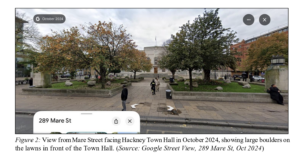
Mare Street, facing Hackney Town Hall, October 2024. Boulders on the lawns. Source: Google Street View.
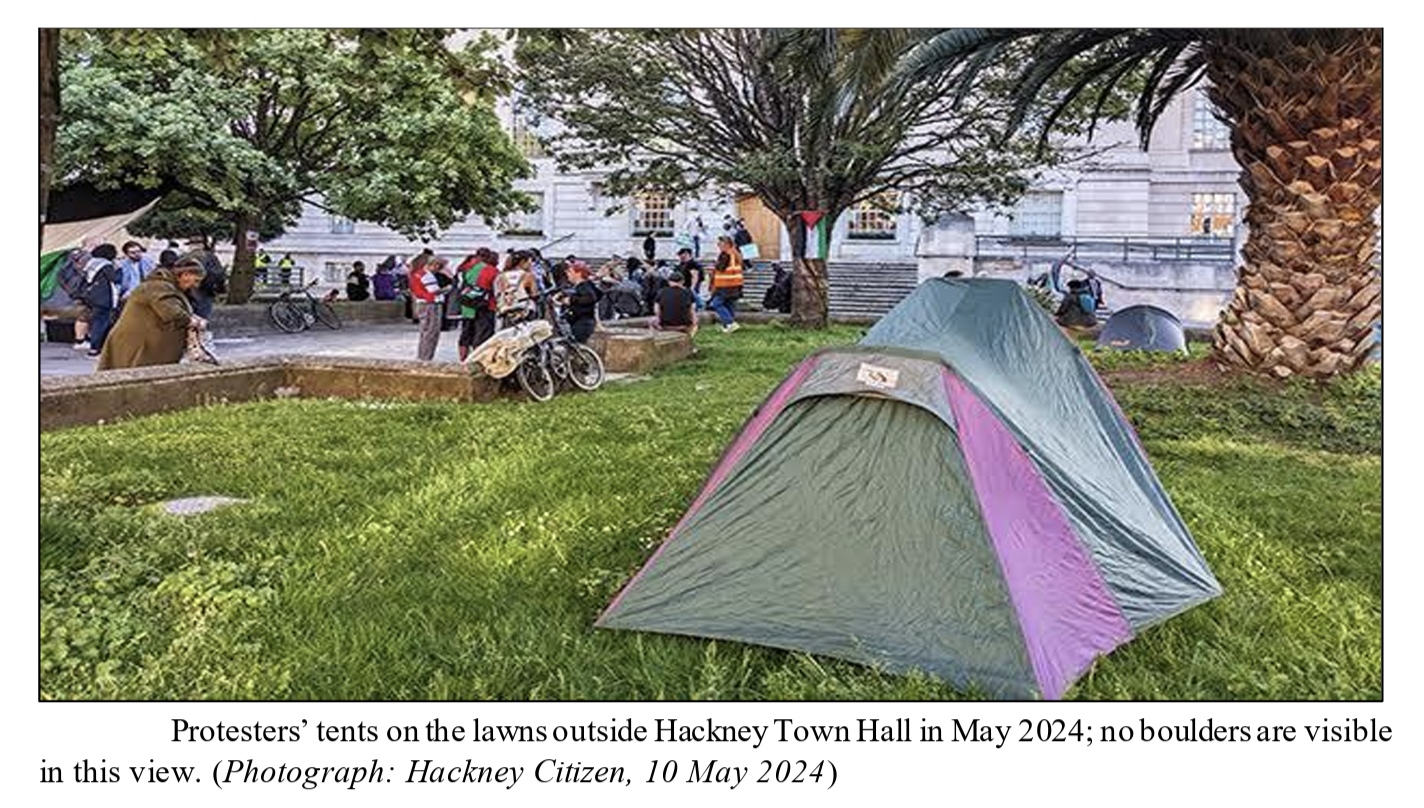
In July 2024, I walked past Hackney Town Hall, and the encampment had gone. Pro-Palestine protesters had been camped on the lawns since May. People sleeping rough had been there too, as the council itself noted. For two months the grass in front of my Town Hall had been doing two jobs at once: protest and shelter.
A few months later I noticed something else. Google Street View from August 2022 shows those lawns bare. The same view from October 2024 shows large boulders scattered across them.
I should say plainly what I have not established. I do not know the date the boulders were installed, who authorised it, or why. Street View records the month an image was captured, not the month the ground changed. What I can show is that something changed, and roughly when.
Here is what makes me uneasy. The council ran a consultation on the future of Hackney Town Hall Square. It opened on 28 September 2024 and closed on 14 October 2024. The image showing the boulders is dated October 2024. On the evidence available to me, the consultation about the square opened at the same time the square had already changed, or after it.
That may have an innocent explanation. The two may be unconnected, and the boulders may have been installed for reasons that have nothing to do with the encampment. The council had already secured government funding for the square in 2023 and approved a wider transformation in 2025. But nobody has published the decision, and I cannot find it.
Protesters’ tents outside Hackney Town Hall, 10 May 2024. No boulders are visible. Photograph: Hackney Citizen.
Henri Lefebvre drew a line between the space planners design on paper and the space people actually live in. Hackney Council describes the area in front of the Town Hall as a platform for political demonstrations. That is the space on paper. The lived space, for two months in 2024, was tents and sleeping bags. Boulders do not stop a demonstration. They do make it considerably harder to sleep.
Don Mitchell argues that public space is always contested, and that street furniture quietly sorts people into those a place is for and those it is not. I am not in a position to say that was the intention here. I am in a position to say that is the effect a boulder has.
The United Nations asks governments to provide universal access to safe, inclusive and accessible public space by 2030, naming women, older people and disabled people in particular. A lawn you cannot lie down on is still accessible to some people and not to others.
When I passed the Town Hall again in October 2026 the boulders had gone and redevelopment was under way. The lawn I grew up walking past will be something else soon.
So the question I am left with is narrow and answerable, and I would like somebody to answer it. Were residents and user groups consulted before the boulders appeared on Hackney Town Hall Square, and if so, where is that consultation recorded? I have looked. I have found a consultation that began in late September 2024, and an image from October 2024 showing the work already done.
I grew up here. The square in front of the Town Hall has always looked to me like the part of the building that belongs to everybody.
I would like to know who decided it should have boulders on it.