

A Californian in London on the first DEN meeting that changed everything, the friends who became loved ones, and the leadership lessons that shape her legal work today
Madeline Briscoe, BA International Relations, University of Westminster (2021–2024); from California, United States; now MA Law student and Citizens Advice Bureau volunteer, based in the United Kingdom
Part of the Inside Westminster anniversary series marking ten years of the Democratic Education Network.
* * *
How did you first come into contact with DEN?
Part of my studies required me to take the module Dilemmas of International Development, convened by Dr Farhang Morady, who has successfully led DEN throughout its existence. I had been struggling to find a community in London after moving from California, so when DEN was presented to us as a unique culmination of community and intellect, I jumped on the opportunity to join.
Which DEN activities have you taken part in?
As a member of DEN, I supported the organisation of social events, reviewed articles written for both the online magazine and the student books, presented at two of the international conferences, and chaired numerous meetings.
Was there a moment at DEN that has stayed with you?
During the first DEN meeting I attended, a classmate shared his experiences of struggling with mental health. At the time, I was floundering. I was newly eighteen, had moved from California to London alone, had never struggled from mental health issues, and had never failed to meet new people. Yet there I was, alone in this big city.
At the time I did not go out of my way to share the impact that this person had had on my psyche. Considering he is now one of my closest friends, it has come up time and time again, and I attribute a huge portion of my resilience to his story. He may not have known how important his story was in that moment, but it taught me, for the first time in a truly full-body way, that I was not alone, even though it felt as though I was invisible.
What aspects of DEN have had the biggest impact on you?
DEN is a really unique place, where Farhang gives students the platform to share whatever they choose. I had always been a writer, producing horribly cheesy novels from an early age, but DEN presented me with the space to create and share who I was at a foundation. Not only did I meet some of my best friends there, but I was able to explore feelings and research that were normally outside the bounds of ordinary conversation and academic work.
While I did not submit everything I wrote, the expectation, or moreover the hope, that I would write something for the online magazine kickstarted a part of my creativity that had gone dormant for quite a long time.
How has DEN helped you develop personally?
DEN is a uniquely accepting place, and that naturally transfers into skills that are normally produced at various different times in your life. When chairing meetings, you learn leadership, and the importance of balancing time, organisation and feedback, in a way that is neither inflammatory nor invasive, while simultaneously asking your colleague to do more. It is a symbiosis of people skills and kindness, something usually developed at some point in one’s professional career, but here with a softer, more human element.
I had struggled throughout my life with being too critical, too harsh, too abrasive. Yet this human element became one of my strongest skills, transferring into my work and my personal life. The very people I was providing constructive feedback to would become my dear friends and my loved ones, and we would often find ourselves out to dinner or at the pub following the weekly Wednesday meetings.
Has DEN helped you with employability or professional development?
The human element of the meetings has been vital to my work now. While I am finishing my Master’s in Law, I have been volunteering with the Citizens Advice Bureau, providing support and advice to members of the community. A lot of my clients are vulnerable, scared, and often misunderstood or misrepresented, and their situations require a soft touch and a kindness that has too often been stepped on in the past. DEN’s critical skills of constructive feedback, coupled with kindness, have given me the necessary tools to provide my clients not only with vital and correct information, but to do so in a way that is not only palatable but empowering.
What is one thing DEN has given you that you would have struggled to find elsewhere?
The community element of DEN is unparalleled. In the professional sphere, you make friends and colleagues can become more than your work friend, but the reality is that work is something you can theoretically leave at the door. DEN, by contrast, has woven its way into the very fibres of my friendships and my personal relationships to this day. My loved ones are the very people I sat next to every day, and would otherwise never have deigned to know.
What advice would you give to students thinking of joining?
DEN is a magical place, but a lot of the magic comes from your own involvement. Do the conference, attend all the meetings, join every social event, and talk to people. Each person who walks through the walls of a DEN event is wholly unique, fascinating, and intelligent, and has something valuable to add.
I have met so many vastly different people, from Vietnam to Uzbekistan, Türkiye, and beyond. That may seem normal for a Londoner, but not for a small-town Californian like myself. The different careers, experiences, stories and personalities each person brings to the table are important, and can be life-changing. They were for me.
What would you say to a colleague at another university?
Join.
Should DEN do anything differently in the next decade?
I truly loved the diversity and the reflective elements of the international conferences that DEN hosted. While I have not been able to engage as fully as I would have liked since graduating from Westminster, more events that fall outside of the working week would be something that may encourage alumni engagement.
* * *
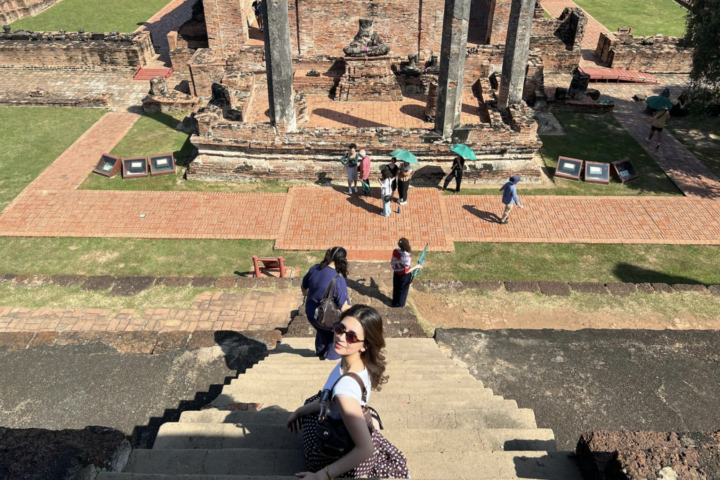
Photo caption: “Reflections from a Californian in London.”



The transition from California to London must have altered your perspective significantly. My personal experience with that kind of movement showed me how quickly new environments reshape one’s outlook.