In conversation with Professor Horacio Gago Prialé, Pontifical Catholic University of Peru
Interview by Negena Mahmoud (BA Politics and International Relations) and Ariadna Rita Lemos De Oliveira (LLM International Law)
Director of the Democratic Education Network
University of Westminster | October 2026
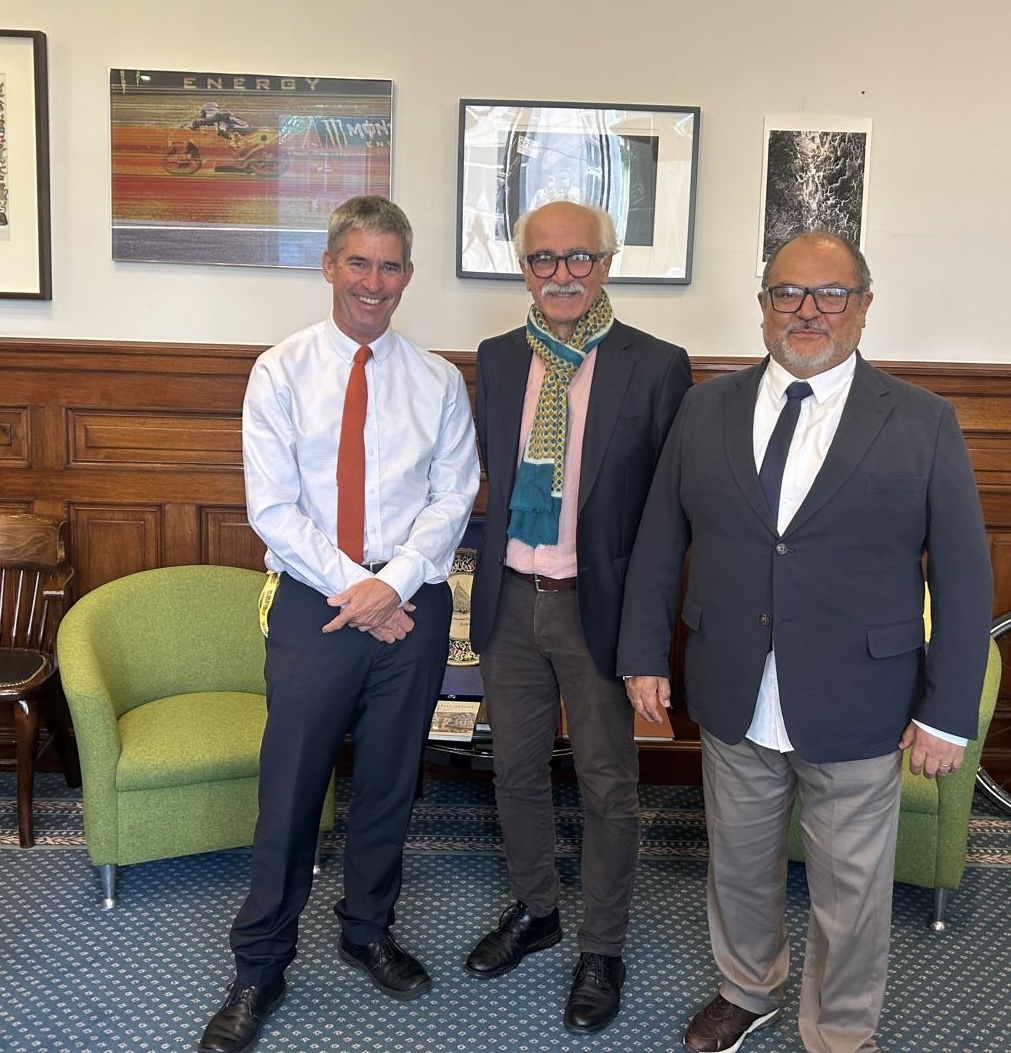
[Photograph]
Pictured: Professor Peter Bonfield, Vice-Chancellor; Associate Professor Farhang Morady, Director of the Democratic Education Network; and Professor Horacio Gago Prialé, Pontifical Catholic University of Peru.
In early October 2026, Professor Horacio Gago Prialé of the Pontifical Catholic University of Peru (PUCP) spent a week at the University of Westminster, meeting senior colleagues, including the Vice-Chancellor and Deputy Vice-Chancellor, and working with students across the Democratic Education Network. During the visit, he led an interactive student workshop, “What does democratic citizenship look like in practice? Peru, the UK and beyond,” and joined an online comparative conversation with academics from DEN’s international partner countries. The week was built on several years of research collaboration between Professor Gago and Dr Morady, spanning political economy, education and the socio-legal study of culture and development, and opened a new chapter in the longstanding partnership between PUCP and the University of Westminster.
This interview, part of DEN’s tenth-anniversary programme, accompanies that visit. In it, Professor Gago reflects on law, cultural diversity and democracy: his intellectual background, Peru’s institutional challenges, and the possibilities for reciprocal learning between students in Peru and the UK.
The answers were translated from Spanish and lightly edited for clarity. The political interpretations expressed are Professor Gago’s owns.
- Could you tell us about your upbringing in Peru and what drew you to law and society?
I was educated at the Salesian Catholic school in Huancayo, my hometown in the central Andes, where the political environment was very active. My maternal grandfather was a very important national leader of APRA, a historic centre-left party. I always knew that socio-legal studies were my calling. I always believed in the possibility of alleviating injustices through the law.
- How does Niklas Luhmann’s systems theory help you understand the complexity of Peruvian society?
The German sociologist Niklas Luhmann, author of systems theory, provides us with very useful tools for understanding the functioning of Peruvian society, characterised by weak institutions, rising expectations and an abundance of soft law. The country has been multicultural for 2,000 years, and this pluralism adds complexity to the present. The legal system seeks to reduce risk but fails due to high levels of protest and social dissatisfaction.
- How have migration, individualism and consumerism changed Peruvians’ expectations of citizenship and democracy?
Peru has always comprised a plurality of nations and cultures and has therefore faced problems rooted in its origins, making it difficult to establish strong institutions. A paradigm that unified this diversity was the shift in migration from the countryside to the city during the second half of the twentieth century. In the city, Peruvians discovered themselves as individuals and aspired to private property as the tangible expression of their new status as citizens. The state promoted the formalisation of land tenure in the late 1990s. Subsequently, it abandoned that policy, and divisions returned. Individualism and consumerism clashed with the original sense of identity. We now find ourselves at that point. The limitations of the market call for a more efficient state.
- What role do property rights and legal certainty play in your vision of equality and cultural coexistence?
The formalisation of property ownership was a practical tool that succeeded in giving concrete expression to the paradigm of equality. Peruvians felt that equality meant improving their circumstances, rather than levelling down. Cultural diversity coexists with the legal certainty provided by property rights. In Europe, property rights are taken for granted. The state must seriously commit itself to building a better framework for formalising the assets of all Peruvians.
- In your presentation, you argued that older political paradigms have lost their force. Why do you think this has happened, and what has replaced them?
The previous paradigms lost their meaning as they gradually became reality: decentralisation was achieved, extreme poverty was overcome, and domination by local landlord bosses was eliminated. But the aftermath was no better. Great disillusionment followed because the public good ceased to be the guiding principle of the political class. This coincided with the arrival of left-wing governments. The left has tended towards an anti-system stance in the twentieth and twenty-first centuries. Criminal groups wielding economic power through trafficking in illegal gold and drugs coexist more comfortably with anti-system forces.
- Your chapter in Reimagining Education in the Age of AI and Global Sustainability examines knowledge creation in societies with ancient and turbulent histories. What role should universities play in Peru’s democracy?
Without doubt, the task is to transform cultural pluralism into a system of institutions designed to provide legal certainty for the various coexisting cultures, respecting the diversity protected by the Constitution and ILO Convention No. 169. Amid this diversity, the university must promote both development—understood as the advancement of freedoms (Amartya Sen)—and the values of democracy: debate, dissent and participation.
- Our collaboration includes Sociedad compleja: Justicia y desarrollo, which I co-edited with Bruno Debenedetti, and your contributions to our forthcoming gastronomy and education volumes. What has this collaboration meant for your work, and how could DEN strengthen links between PUCP and Westminster?
This collaboration has meant a great deal to me. It has required me to shift from my worldview as a legal scholar from a Latin American country with weak institutions towards the perspective characteristic of the UK, where legal certainty is taken for granted. It is essential to strengthen the relationship between the University of Westminster and the Pontifical Catholic University of Peru (PUCP), because Peru offers an illustrative example of cultural diversity and its contemporary challenges. Much can be learned in the UK from diverse societies such as Peru’s.

- What would you say to Westminster students considering studying in Peru, and to Peruvian students interested in joining DEN?
I invite students at the University of Westminster to experience the vibrant social movements in Peru, bearing in mind Peru’s rapid development as an emerging country alongside its lack of strong institutions. To Peruvian students, I would emphasise the importance of understanding, through practical experience, how democracy is built in stable societies such as Britain.

- Is there anything else you would like to add?
I express the hope that exchanges between our universities will grow stronger, enriching the global knowledge and experience of each and every student at both institutions.